
Skip to content

Search

Find insights, training programs, and workshops

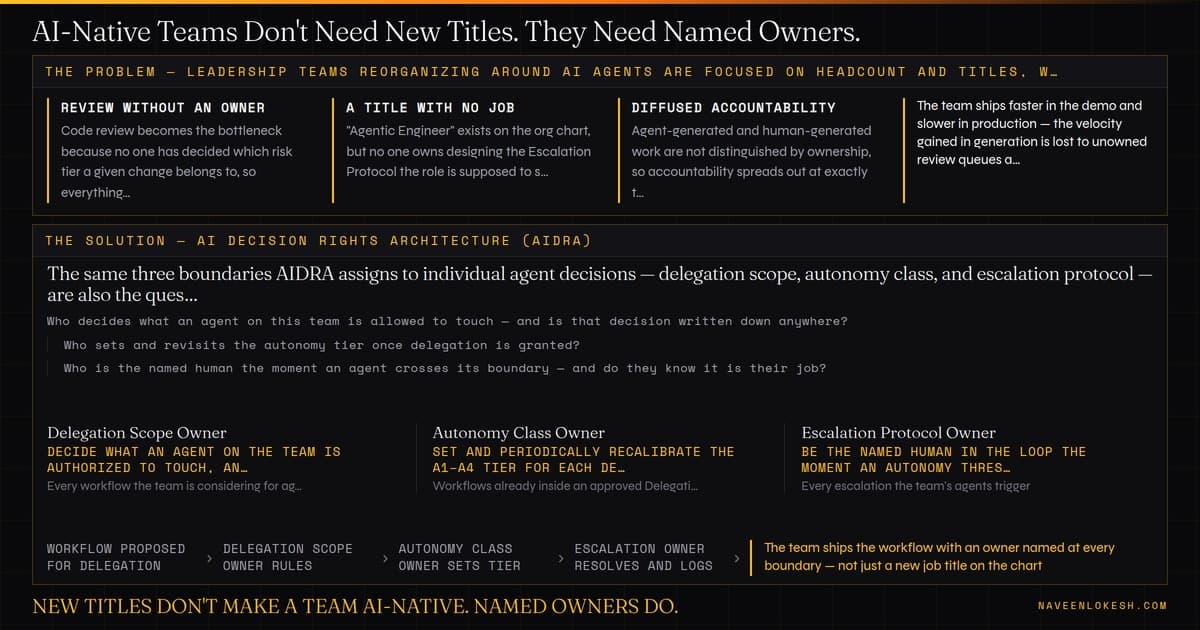
AI-Native Teams Don't Need New Titles. They Need Named Owners.

AI-native team redesigns keep adding new job titles and calling it done. The actual failure mode sits at the decision boundary. Here is what changes when you apply AIDRA to team design instead of headcount.

...Scope, Autonomy Class, and Escalation Protocol each have a named owner Core outcome: A role-assignment model — Delegation Scope Owner, Autonomy Class Owner, Escalation Protocol Owner — that can be layered...

Your Architecture Diagrams Are Lying to You

Why architecture diagrams describe a system that no longer exists, and how Observable Architecture uses production telemetry to reveal what is actually running.

...something important breaks. Architecture reviews happen against the wrong picture. Security threat models assess a system that does not exist. Capacity planning models flows that were replaced eighteen...

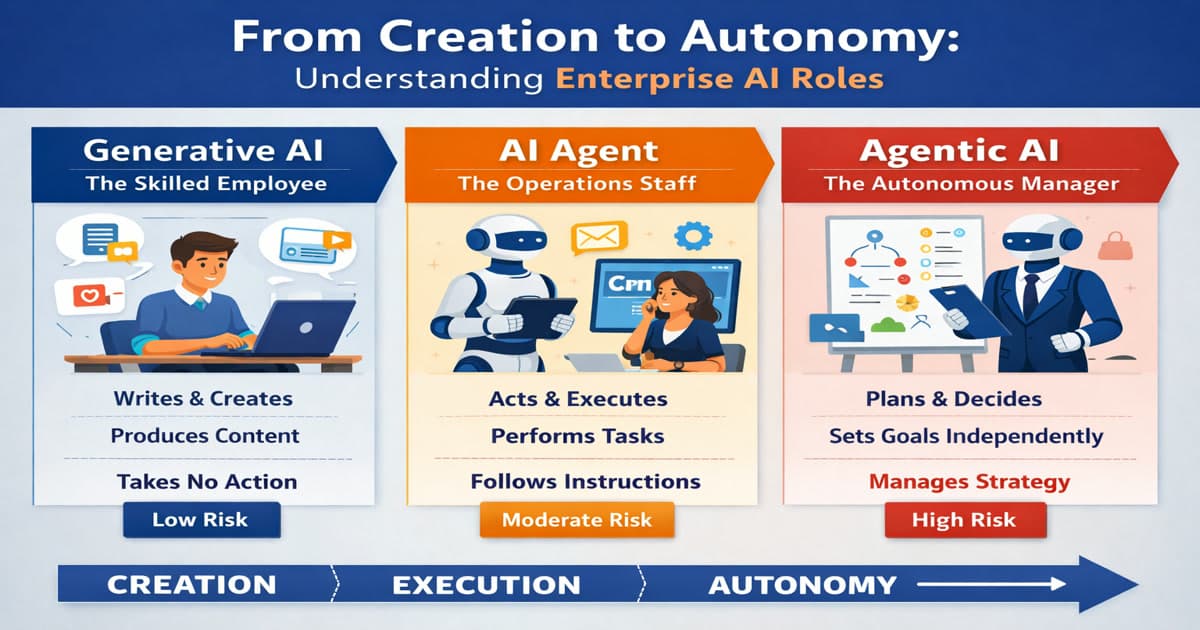
From Creation to Autonomy: Understanding Generative AI, AI Agents, and Agentic AI Through a Workplace Analogy

A clear executive guide explaining Generative AI, AI Agents, and Agentic AI using a corporate office analogy to prevent autonomy risks in enterprise AI.

...into delegated authority territory without any governance framework. We built an autonomy governance model that defined, for each agent, what it could decide alone, what it must propose, and what it could...

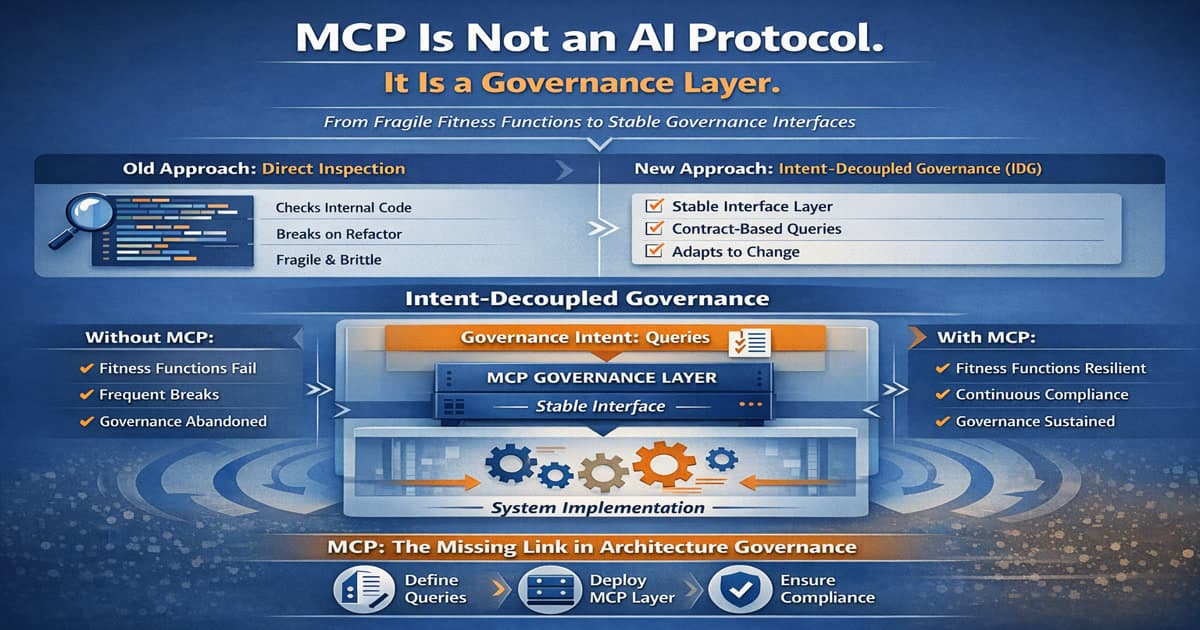
MCP Is Not an AI Protocol. It Is a Governance Layer.

MCP is classified as an AI integration protocol. It is actually a governance primitive — the stable interface layer that architecture fitness functions have been missing for years.

...implementation — making governance brittle, ignored, and eventually abandoned Key outcome: A structured model that uses MCP servers as a stable indirection layer between governance intent and delivery implementation...

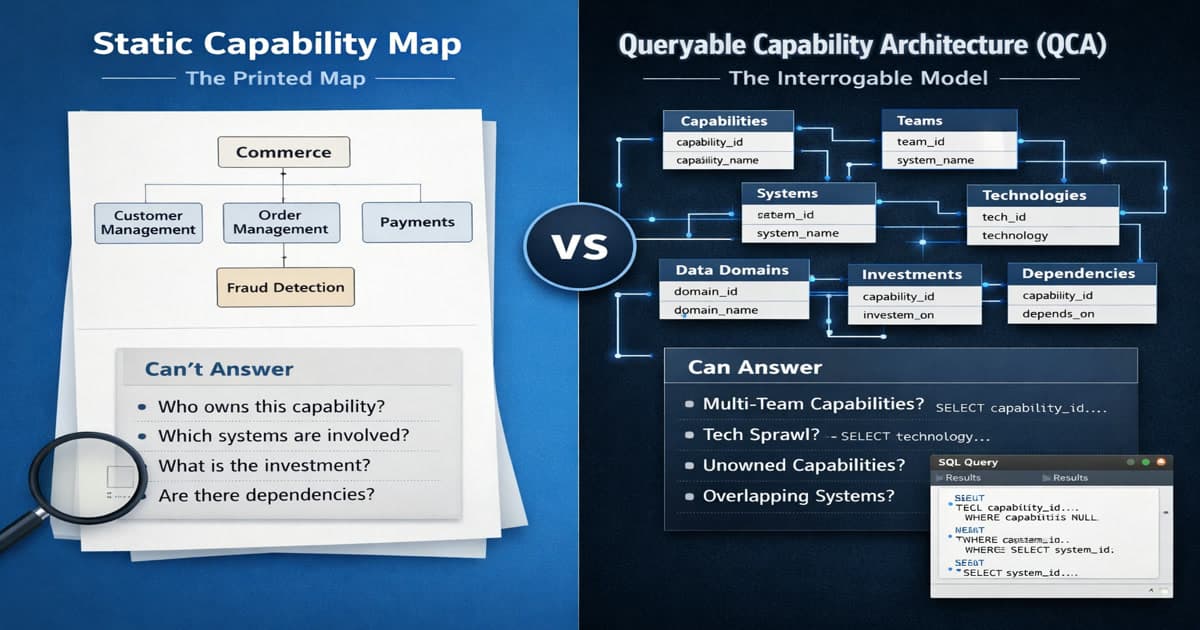
The Capability Map That Cannot Answer a Question Is Not a Capability Map

Why traditional capability maps fail to support governance decisions and how Queryable Capability Architecture turns static maps into interrogable decision systems.

...architecture intelligence Time to implement: 30–60 days to build a structured queryable capability model Business impact: Better governance decisions, clearer ownership visibility, reduced technology...

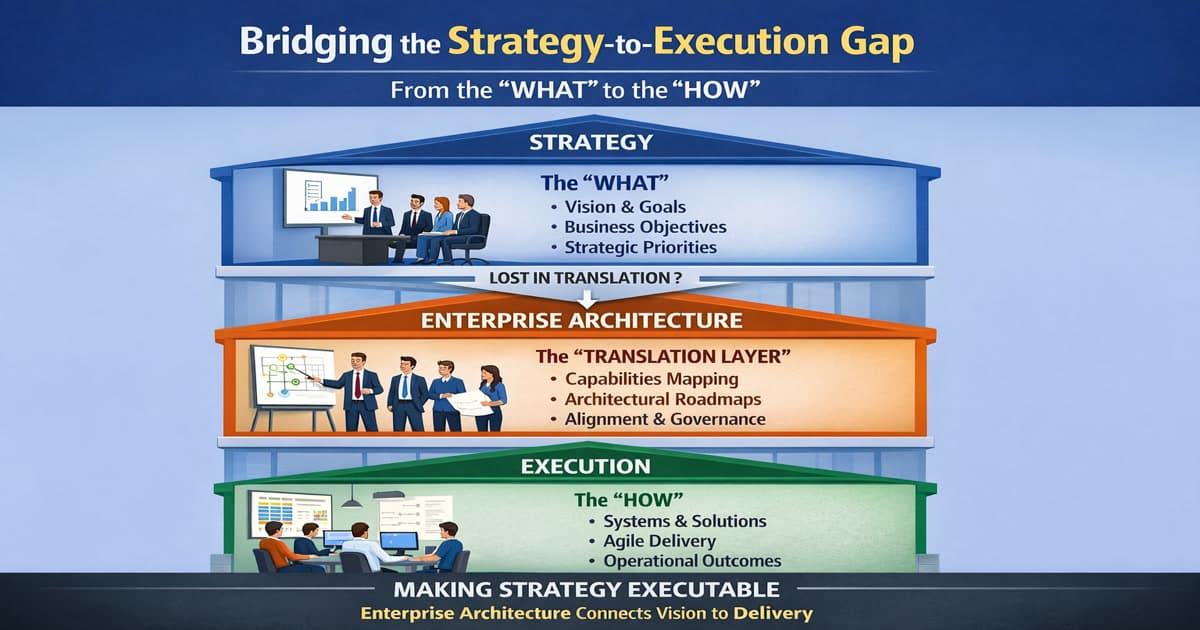
The Strategy-to-Execution Gap: How Enterprise Architecture Bridges the 'What' and the 'How'

Why strategic intent evaporates before it reaches engineering teams — and how Enterprise Architecture creates the translation layer that makes organizational strategy executable.

...backlog — with no structured layer to translate it Key outcome: A practical three-layer translation model that makes organizational strategy traceable all the way to delivery Time to implement: 30–60 days...

Technology, Infrastructure, Cloud & Security Design
Intermediate to Advanced (SA, EA)6-8 hoursInfrastructure decision framework + cloud pattern reference + security controls map

Where abstract architecture meets physical reality — choosing the platforms, compute, networking, and security controls that make the solution work at scale.

...complexity, and lock-in. The decisions that matter most: What to run it on — cloud provider, service model, region. How to secure it — zero trust, least privilege, defence in depth. How much it costs —...

2 DaysIntensive
PracticalSA · EA
AI Procurement, Vendor Evaluation & Tool Selection
Beginner to Intermediate3-4 hoursVendor evaluation scorecard + tool selection checklist + risk review template

Choosing AI tools is not a beauty contest. Learn how to evaluate vendors, compare capabilities, assess risk, avoid lock-in, and buy systems that your organisation can actually govern and adopt.

...reveal the truth How to run a sane selection process The politics of platform choice The selection model in one diagram Cheat sheet Before we start — why buying AI is unusually noisy AI markets are...

Half DayDecision Focused
Vendor SelectionPractical
Responsible AI — Ethics, Risk & Governance
Beginner to Intermediate4-5 hoursAI risk map + personal responsibility checklist + governance starter framework

Using AI responsibly — covering ethics, bias, hallucination risk, data privacy, accountability, and organisational governance. The judgment to use AI fairly, safely, and in a way you can defend.

...and the world's data encodes the world's history — including its inequalities. If you train a hiring model on ten years of decisions made by humans who (consciously or not) favoured certain candidates,...

1 DayIntensive
Beginner FriendlyNo legal background required
AI Evaluation, Testing & Validation
Intermediate to Advanced4-6 hoursEvaluation framework + test matrix + validation workflow

If you cannot evaluate an AI system, you cannot trust it. Learn how to test prompts, retrieval, agents, workflows, and production behaviour before confidence turns into risk.

...review Metrics that matter Evaluating prompts, RAG, and agents Test set design and edge cases Validation as an operating habit What "good enough" actually means The evaluation loop in one diagram Cheat sheet Before...

1 DayHands-on
ValidationCore Discipline