Skip to content

Search

Find insights, training programs, and workshops

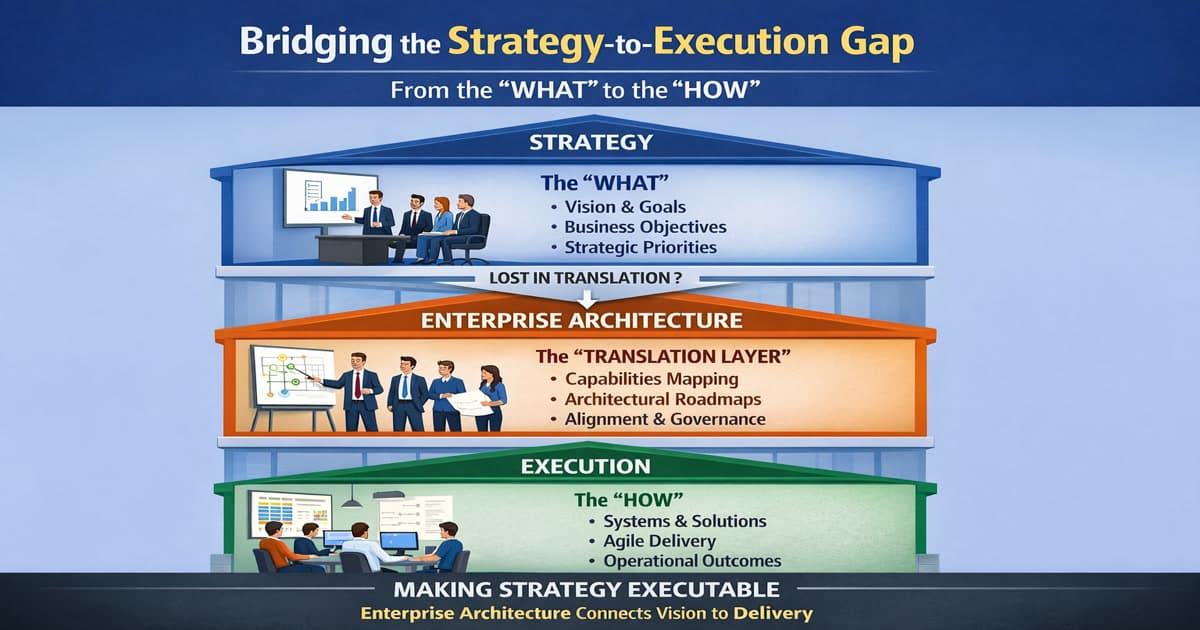
The Strategy-to-Execution Gap: How Enterprise Architecture Bridges the 'What' and the 'How'

Why strategic intent evaporates before it reaches engineering teams — and how Enterprise Architecture creates the translation layer that makes organizational strategy executable.

...why the system is structured the way it is. New proposals get evaluated in a vacuum. Every design review becomes a debate without reference to strategic context. The architecture reflects accumulated...

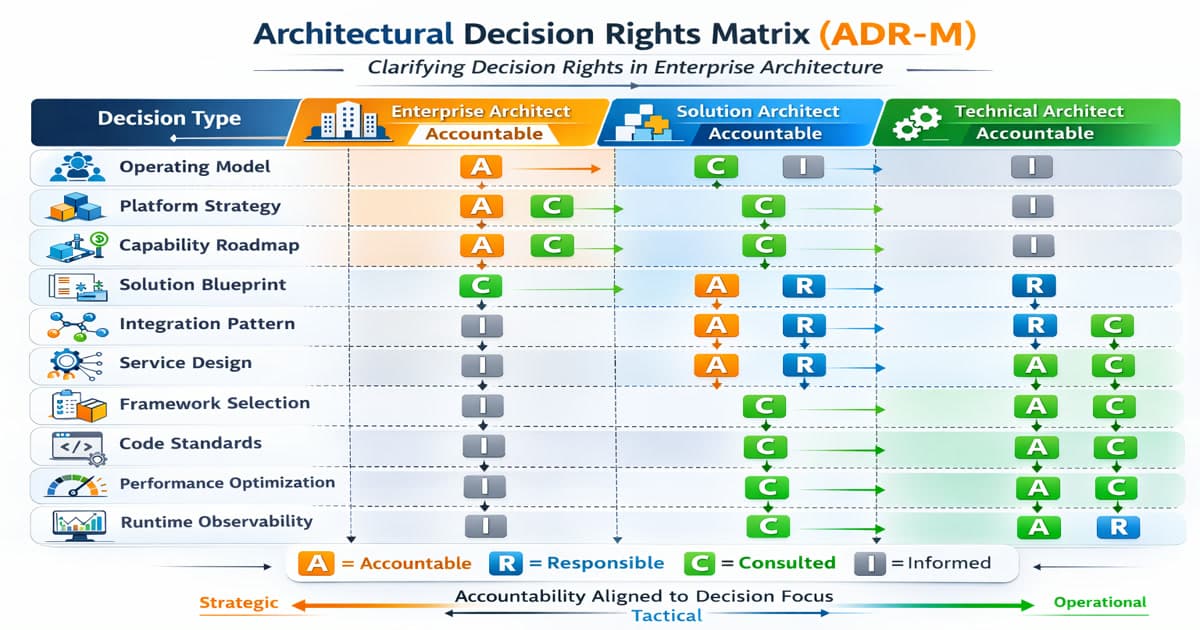
Architectural Decision Rights Matrix: Governing Enterprise, Solution, and Technical Architecture

A governance framework introducing the Architectural Decision Rights Matrix (ADR-M) to clarify accountability between Enterprise, Solution, and Technical Architects in Context-Driven Architecture.

...constraints. Why This Matters When accountability is unclear: Duplicate platforms emerge Architectural reviews become political Delivery slows Governance weakens Technical debt accelerates When altitude...

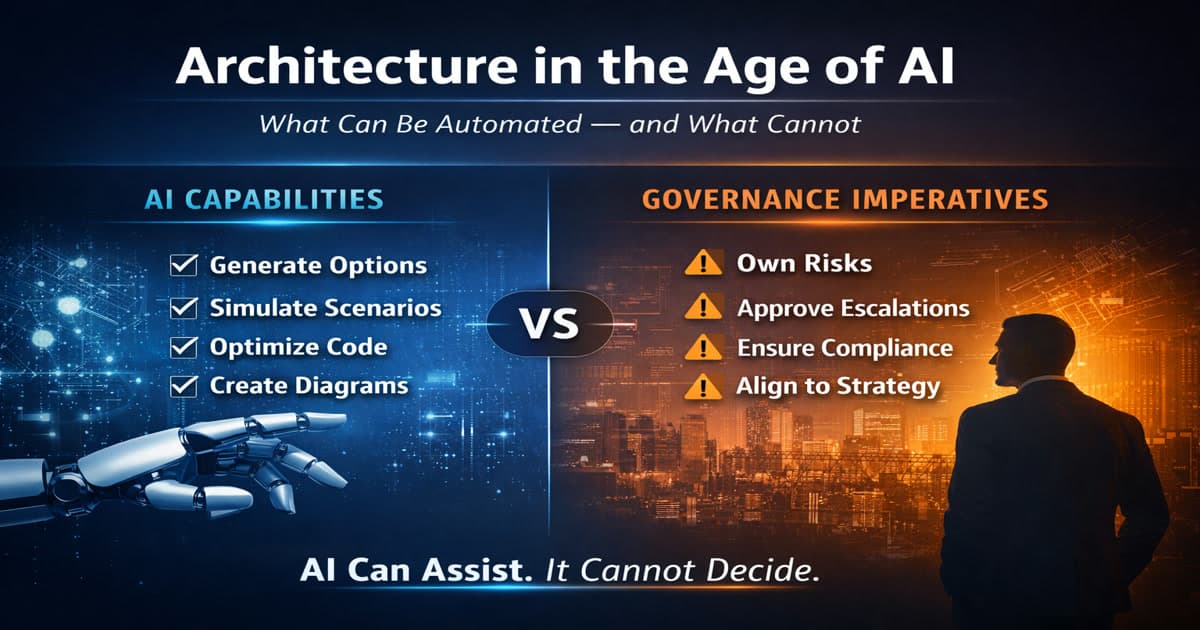
Architecture in the Age of AI: What Can Be Automated — and What Cannot

A governance-driven perspective explaining why software architecture cannot be automated because decision accountability and consequence ownership cannot be delegated to AI.

...Matrix) framework to classify the AI-generated proposal as a recommendation requiring architect-level review — not an executable design. The architect reviewed it, found two structural flaws that would have...

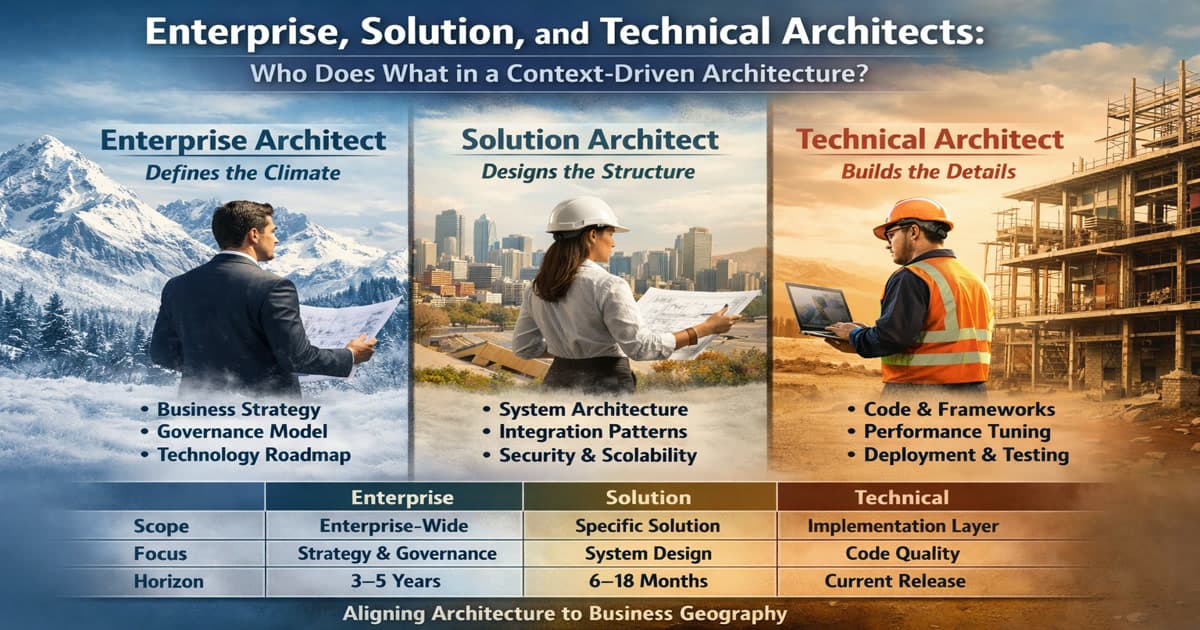
Enterprise, Solution, and Technical Architects: Who Does What in a Context-Driven Architecture?

A structured executive guide explaining the difference between Enterprise, Solution, and Technical Architects using Context-Driven Architecture to clarify responsibilities and reduce structural misalignment.

...ownership by role Separate strategic, structural, and implementation decisions Introduce cross-role review checkpoints Success Metric: Reduced architectural friction and faster decision cycles Evidence...

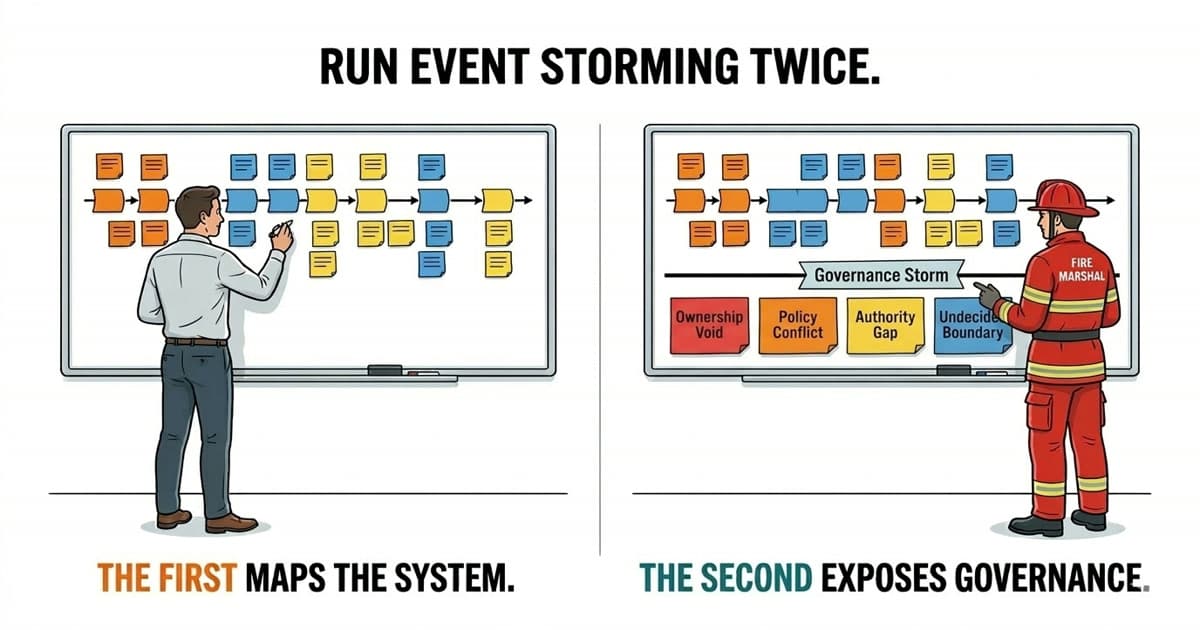
Run Event Storming Twice. The First Maps the System. The Second Exposes Governance.

Why the second run of an Event Storming workshop — the one most teams never attempt — is the fastest way to surface governance gaps that architecture diagrams will never show.

...Conflicts and Undecided Boundaries that require cross-team or leadership decisions. Assign to Architecture Review Board with a time-bounded resolution date. Accept and document: Governance gaps that are known,...

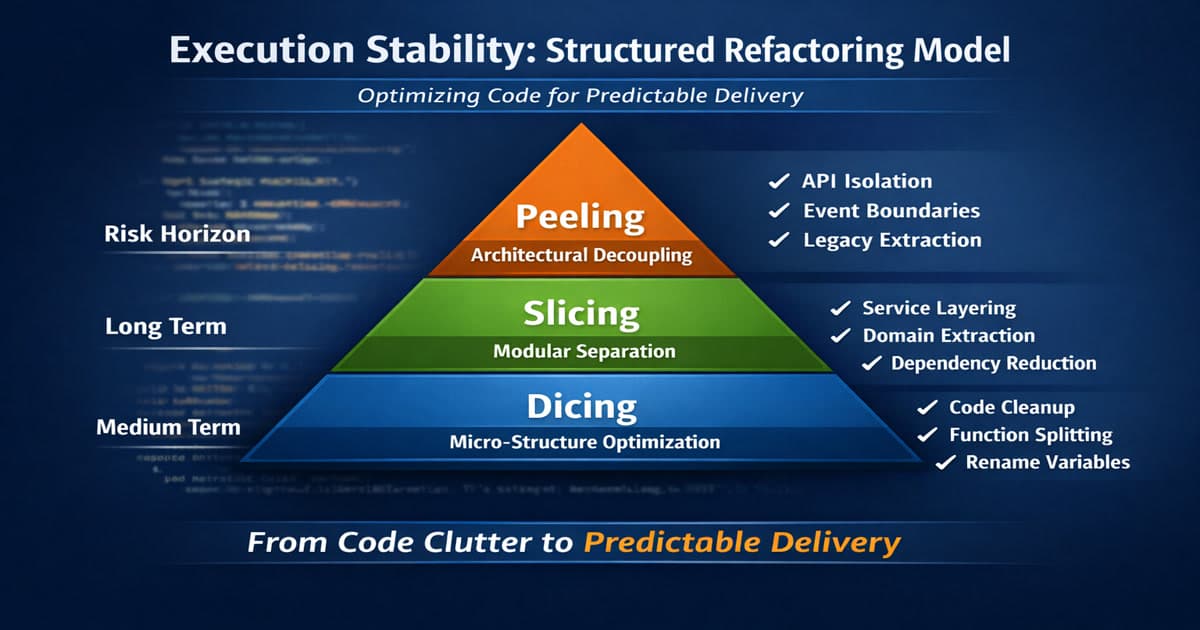
Execution Stability: How Structured Refactoring Improves Delivery Predictability

A practical framework for reducing delivery slowdown caused by unmanaged structural code complexity — improving cycle time, reducing regression risk, and clarifying ownership boundaries.

...metrics. The result: Teams argue about how much to refactor Delivery slows unpredictably Architecture reviews become subjective Technical debt becomes political Refactoring must move from instinct to...

Risk, Compliance & Control Points
Intermediate to Advanced (SA, EA, TS)5-6 hoursRisk and control register template + compliance mapping guide + architecture risk heat map

How architecture manages technical risk and meets regulatory obligations — covering architectural risk analysis, compliance by design, privacy by design, security controls as decisions, operational risk, control points, and demonstrating compliance through architecture.

...data flows, and access controls — determines its exposure. I've seen teams wait until the security review to think about encryption. By then, it's too late. Technical risk is architectural risk. Compliance...

1 DayIntensive
CriticalSA · EA · TS
Standards & Reference Architectures
Intermediate (SA, EA)4-5 hoursReference architecture library starter + standards register + architecture principles catalogue

How to create, govern, and operationalise architecture standards and reference architectures — the agreed patterns and structures that create consistency, reduce duplication, and accelerate delivery at scale.

...with 47 distinct technologies across 12 teams. Hiring was difficult. Integration was painful. Security review was overwhelmed. Standards and reference architectures are the agreed patterns, principles, and...

1 dayIntensive
PracticalStandards exercise
AI Evaluation, Testing & Validation
Intermediate to Advanced4-6 hoursEvaluation framework + test matrix + validation workflow

If you cannot evaluate an AI system, you cannot trust it. Learn how to test prompts, retrieval, agents, workflows, and production behaviour before confidence turns into risk.

...demo trap Why evaluation matters What exactly are you evaluating Offline tests, live tests, and human review Metrics that matter Evaluating prompts, RAG, and agents Test set design and edge cases Validation...

1 DayHands-on
ValidationCore Discipline
Effective Prompt Engineering
Beginner to Advanced6-8 hoursFull prompt design framework + personal prompt library

Every major prompt engineering technique — from basic clarity to advanced agentic reasoning. Not a list of tips. A mental model you can apply to any task, any tool, any context.

...quality Prompt Chaining — one task per prompt Generated Knowledge — prime before you ask Self-Critique — make it review itself Meta-Prompting — ask it to write the prompt ReAct — reason and act together Emotional Prompting...

2 DaysIntensive
19 TechniquesComplete Coverage
1···456···11