Skip to content

Search

Find insights, training programs, and workshops

AI Capabilities, Limitations & Use Cases
Beginner to Intermediate3-4 hoursTask-to-AI fit judgment + reference materials

What AI is genuinely good at, where it will let you down, and how to match the right task to the right tool. The judgment you need before you touch a prompt.

Quick Navigation The honest starting point What AI does well — the 7 strengths Where AI fails — the 5 limitations Hallucination — the one that causes...

Half DayIntensive
Beginner FriendlyNo math required
AI Policy, Security & Organisational Controls
Beginner to Intermediate4-5 hoursAI policy checklist + security controls map + incident response starter template

Building and enforcing AI policy — the practical mechanisms that turn ethical principles into enforceable organisational rules. Data security, access controls, audit trails, and incident response.

Quick Navigation The enforcement gap Anatomy of an AI policy Data security Prompt injection and adversarial risk Access controls Audit trails and logging Incident...

1 DayIntensive
Beginner FriendlyNo legal background required
Future of AI
Intermediate to Senior Leaders3-4 hoursAI horizon scan + strategic implications analysis + preparation roadmap

What's coming in AI — multimodal models, on-device AI, open-source momentum, protocols, regulation, and the shift to AI-native organisations. See around the corner without falling for hype.

Quick Navigation Separating signal from noise Multimodal AI — beyond text On-device AI — local, private, fast Open source and democratisation Protocols and the...

Half DayIntensive
Horizon ScanDeliverable
Standards & Reference Architectures
Intermediate (SA, EA)4-5 hoursReference architecture library starter + standards register + architecture principles catalogue

How to create, govern, and operationalise architecture standards and reference architectures — the agreed patterns and structures that create consistency, reduce duplication, and accelerate delivery at scale.

Quick Navigation Start here — What standards are Types of standards What reference architectures are Creating standards that get adopted Governing standards Reference architecture examples Consistency...

1 dayIntensive
PracticalStandards exercise
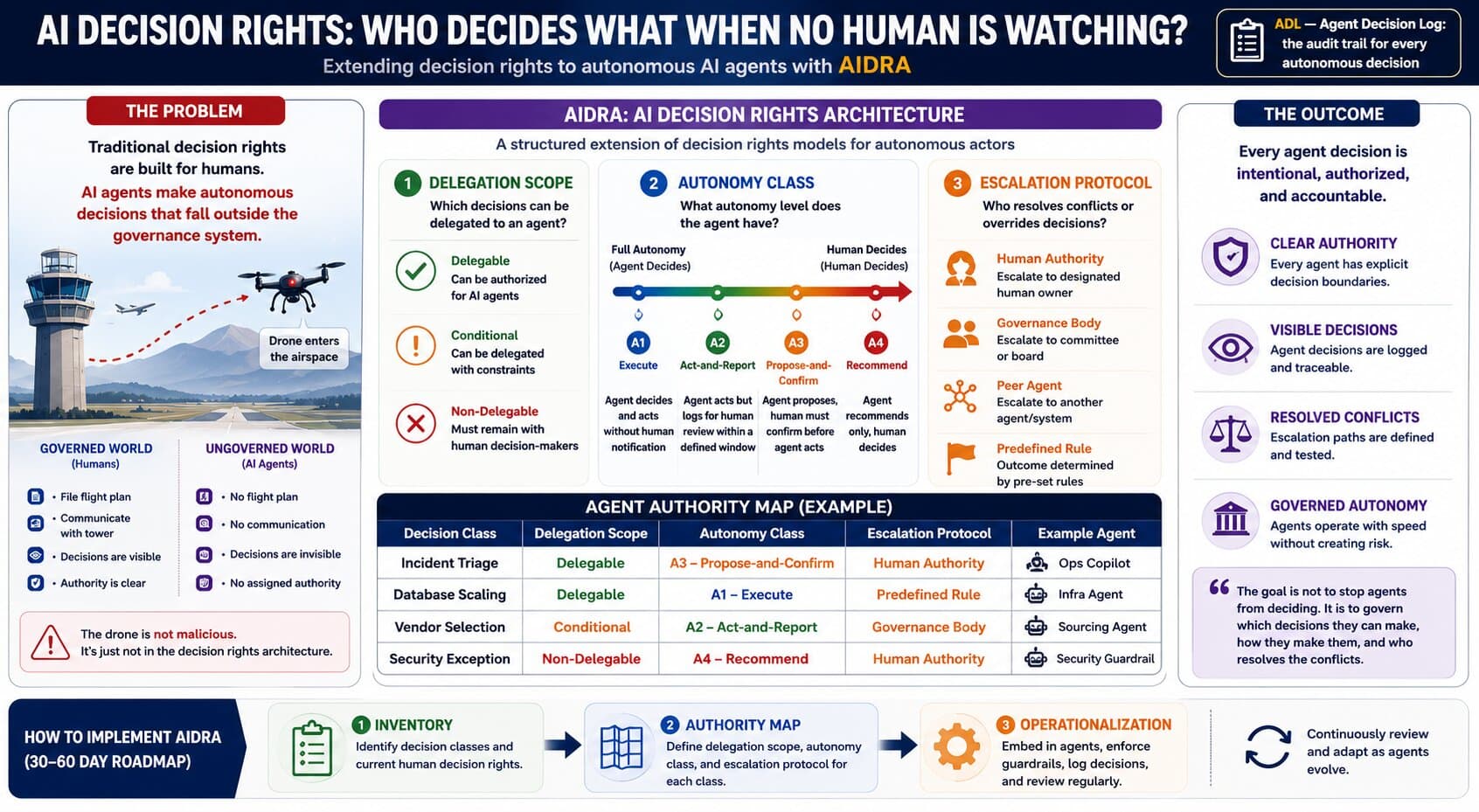
AI Decision Rights: Who Decides What When No Human Is Watching?

Decision rights models assume human decision-makers. AI agents breach that assumption silently. Here is how to extend decision rights to cover autonomous actors before the first ungoverned decision becomes a production incident.

Executive Summary Who this is for: CTOs, Enterprise Architects, AI Governance Leads, Architecture Board Members, Heads of Engineering Problem it solves: Decision rights...

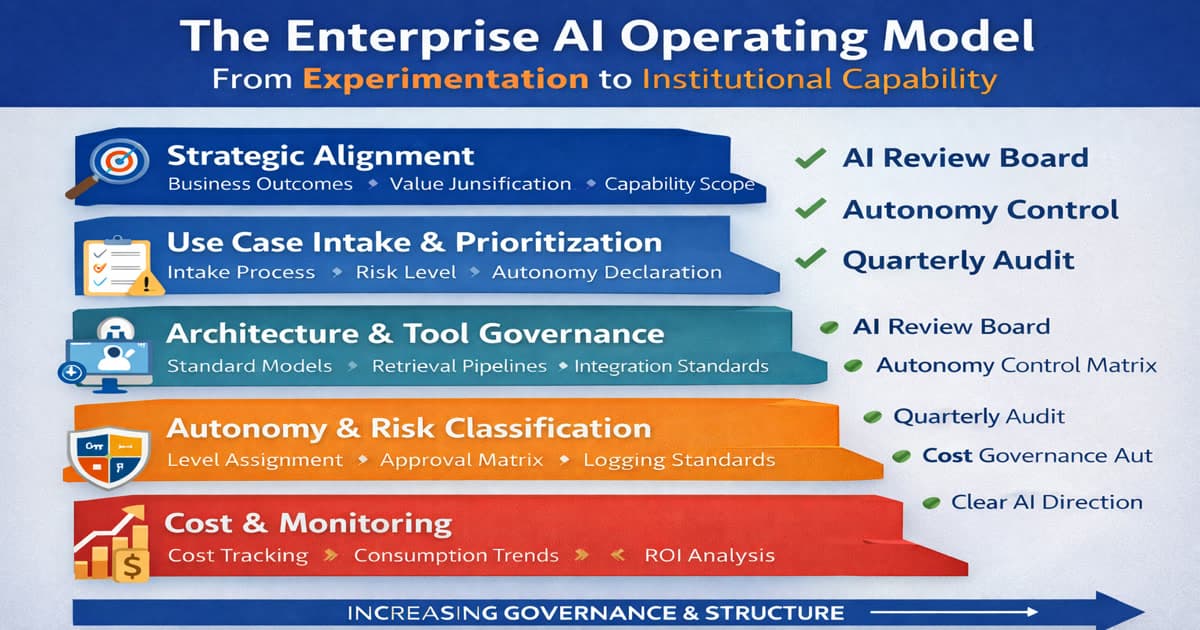
The Enterprise AI Operating Model: From Experimentation to Institutional Capability

A structured executive guide explaining how to move from AI experimentation to an Enterprise AI Operating Model with governance, autonomy control, and cost discipline.

Executive Summary Who this is for: CIOs, CTOs, Enterprise Architects, AI Transformation Leaders Problem it solves: AI initiatives running as disconnected pilots without governance...

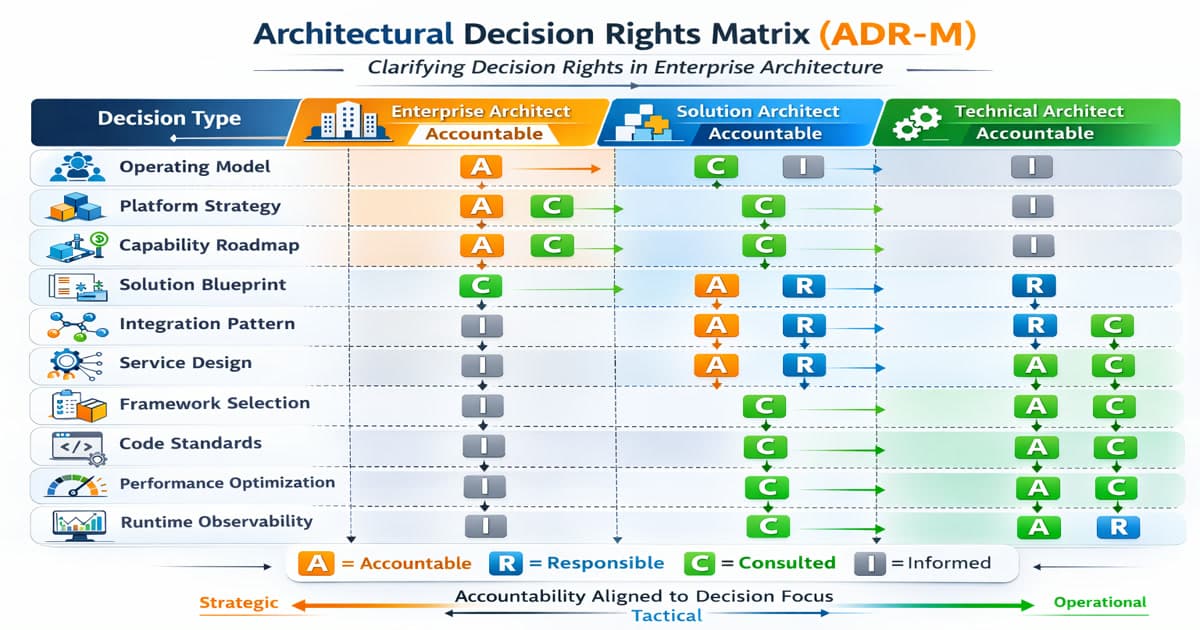
Architectural Decision Rights Matrix: Governing Enterprise, Solution, and Technical Architecture

A governance framework introducing the Architectural Decision Rights Matrix (ADR-M) to clarify accountability between Enterprise, Solution, and Technical Architects in Context-Driven Architecture.

Executive Summary Who this is for: CIOs, CTOs, Enterprise Architects, Architecture Governance Leaders Problem it solves: Architectural role confusion leading to duplicated...

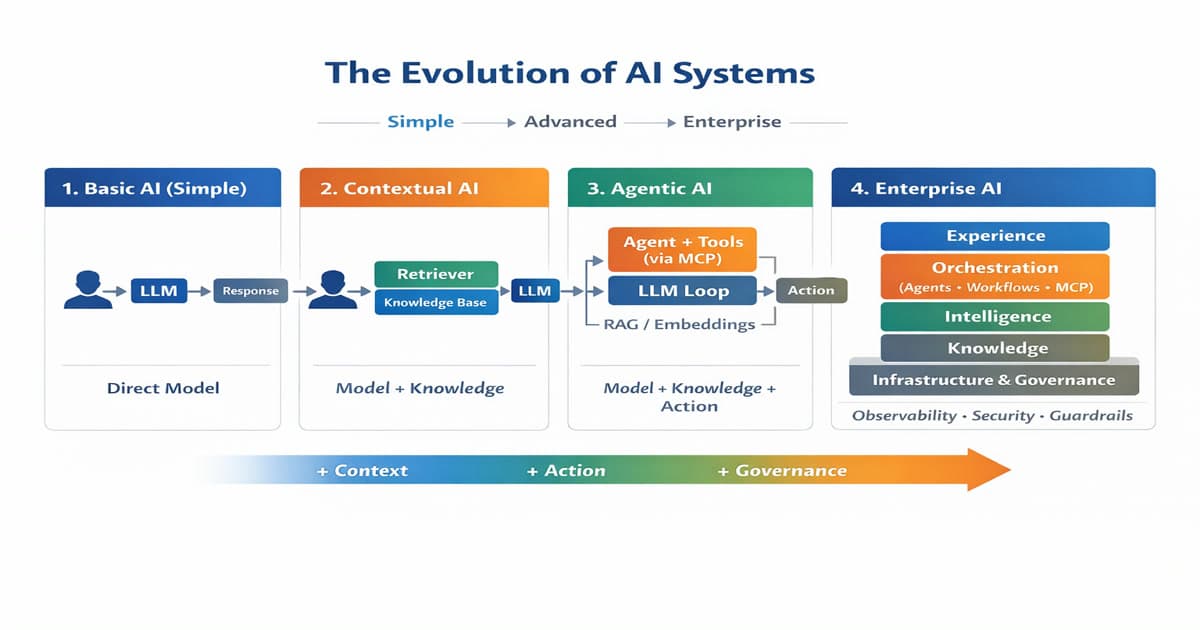
The AI Evolution Stack: How AI Systems Mature from Simple Models to Governed Platforms

A structured guide explaining how AI systems evolve from simple model usage to governed platforms, and how to scale complexity without losing architectural control.

Executive Summary Who this is for: Technology leaders, architects, founders scaling AI beyond experimentation Problem it solves: AI systems growing in complexity without proportional governance Key...

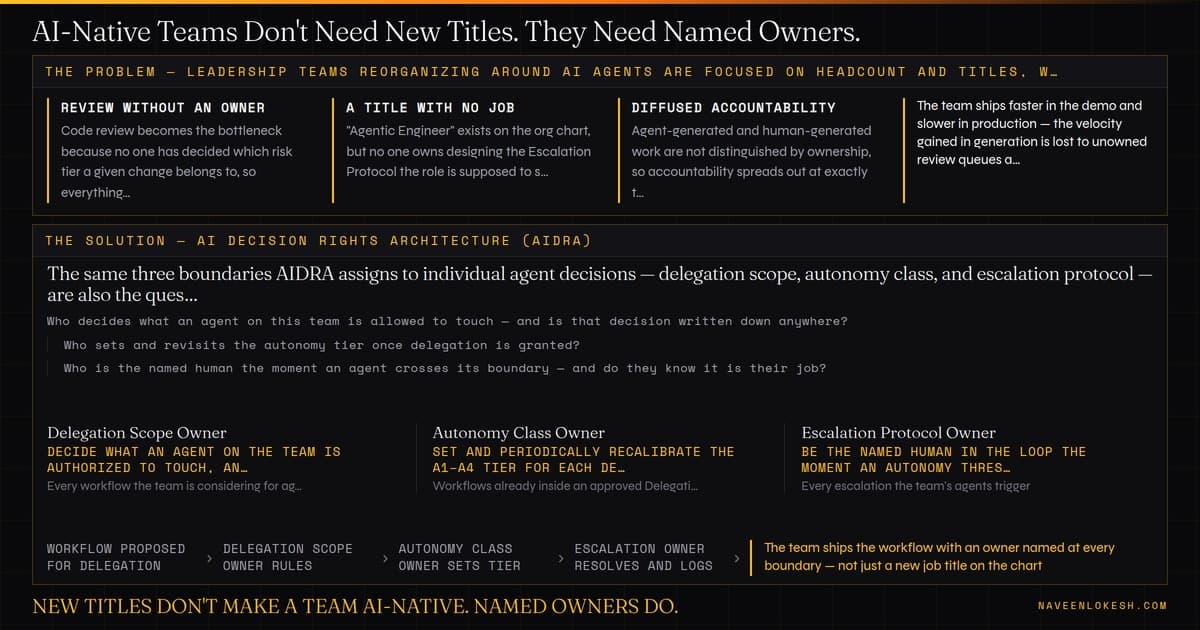
AI-Native Teams Don't Need New Titles. They Need Named Owners.

AI-native team redesigns keep adding new job titles and calling it done. The actual failure mode sits at the decision boundary. Here is what changes when you apply AIDRA to team design instead of headcount.

...Heads of Platform, Engineering Directors, Team Leads adopting agentic workflows Problem it solves: AI-native team redesigns focus on new job titles and shrinking headcount, while the actual failure mode...

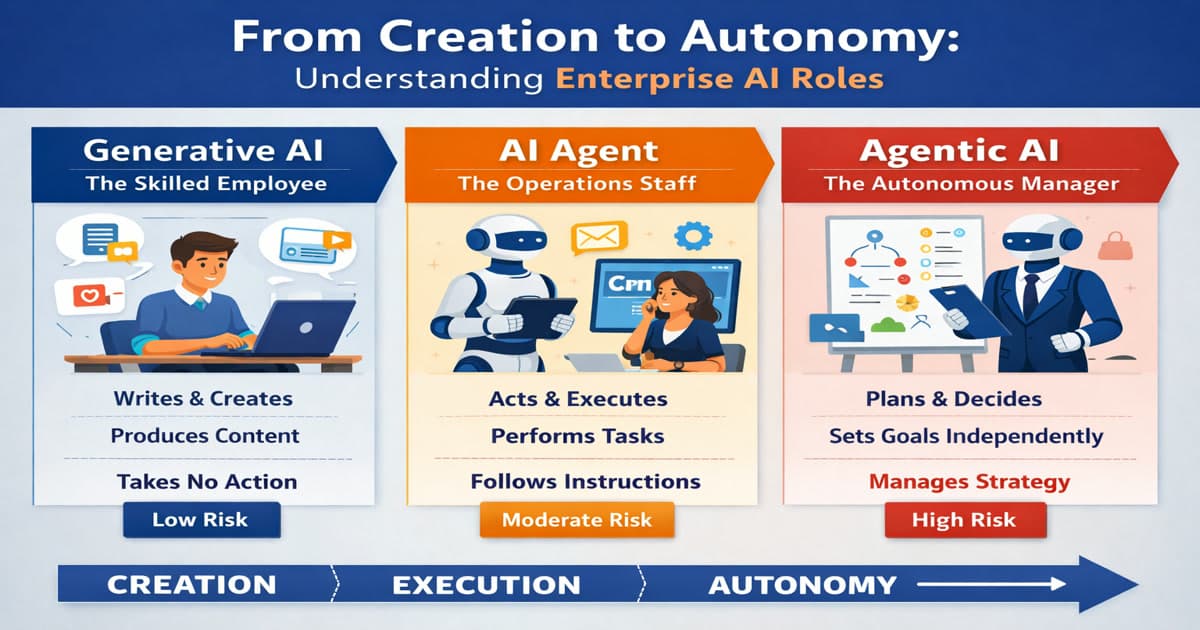
From Creation to Autonomy: Understanding Generative AI, AI Agents, and Agentic AI Through a Workplace Analogy

A clear executive guide explaining Generative AI, AI Agents, and Agentic AI using a corporate office analogy to prevent autonomy risks in enterprise AI.

Executive Summary Who this is for: CIOs, CTOs, Enterprise Architects, AI Strategy Leaders Problem it solves: Confusion between Generative AI, AI Agents, and Agentic AI leading...