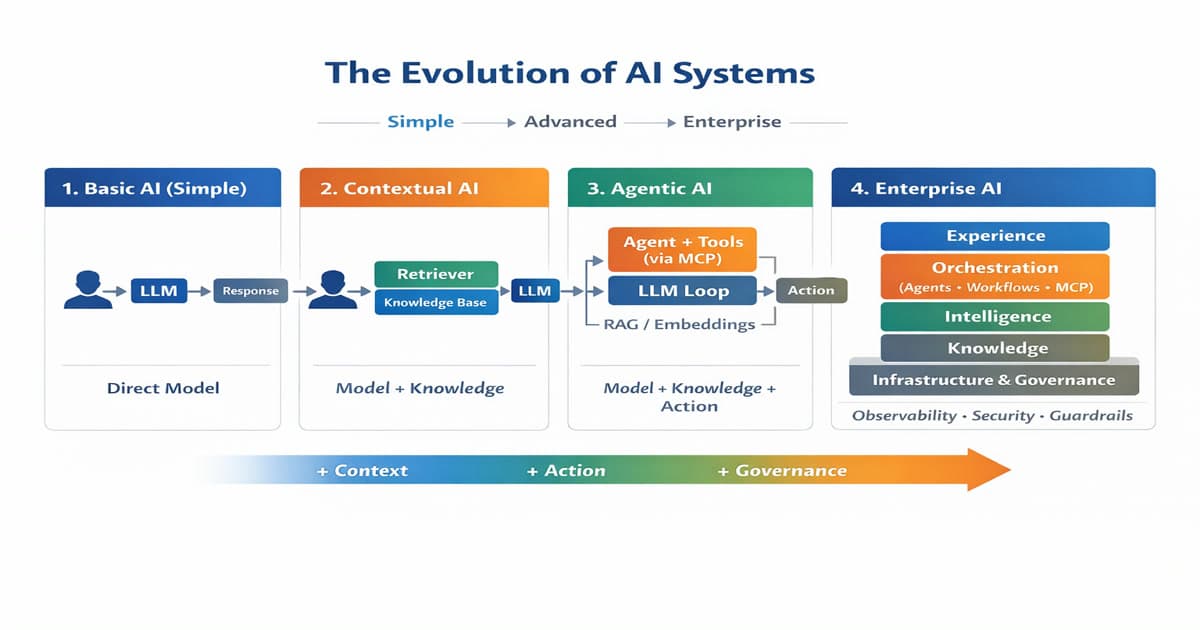
The Problem: AI Without an Operating Model
Most organizations are experimenting with AI.
Different teams:
- Use different models
- Build separate agents
- Integrate tools independently
- Run pilots without cross-review
Six months later:
- Costs fluctuate unpredictably
- Security escalations slow progress
- Compliance reviews increase friction
- Executives hesitate to scale
The issue is not capability.
The issue is structural absence.
AI is being treated like a tool.
It must be governed like a platform.
The Shift: From Experimentation to Institutional Capability
Pilots prove possibility.
Operating models enable scale.
Without an operating model:
- Autonomy increases without oversight
- Tool access expands without control
- Cost scales without accountability
- Strategy drifts from execution
Enterprise AI requires intentional structure.
The Five Layers of an Enterprise AI Operating Model
1. Strategic Alignment Layer
Questions to answer:
- What business outcomes is AI expected to impact?
- Is AI cost justified by measurable value?
- Which capabilities are assistive vs autonomous?
AI initiatives must map to enterprise objectives.
Not curiosity.
Not hype.
2. Use Case Intake & Prioritization
Introduce a formal intake process:
- Business sponsor defined
- Risk classification assigned
- Autonomy level declared
- Data sensitivity identified
- ROI hypothesis documented
If a use case cannot pass intake review,
it should not move to development.
Discipline precedes innovation.
3. Architecture & Tool Governance
AI systems must follow architectural standards:
- Approved LLM providers
- Standardized retrieval pipelines
- Controlled tool exposure
- Defined integration patterns
- Logging requirements
AI must integrate into your architecture review process.
Not bypass it.
4. Autonomy & Risk Classification
Every AI capability must be classified as:
- Creation (Generative)
- Execution (Agent)
- Delegated Decision Authority (Agentic)
Each category requires:
- Defined boundaries
- Escalation rules
- Approval checkpoints
- Audit logging
Autonomy should never be implicit.
It must be explicitly approved.
5. Cost & Performance Monitoring
AI introduces variable cost dynamics.
You must monitor:
- Cost per workflow
- Token consumption trends
- Tool invocation frequency
- ROI per use case
- Failure rate and rework
AI without financial visibility becomes operational liability.
Cost governance is not optional.
Governance Structure Required
To institutionalize AI, establish:
1. AI Review Board
- Architecture representation
- Security & compliance
- Business sponsor
- Finance oversight
2. Autonomy Approval Matrix
Define:
- What AI may generate
- What AI may execute
- What AI may decide
3. Quarterly AI Structural Audit
- Tool access review
- Cost variance analysis
- Risk reclassification
- Sunset underperforming use cases
AI should be reviewed like cloud architecture or cybersecurity posture.
Implementation Roadmap (90 Days)
Phase 1: Inventory (Weeks 1–3)
- List all AI use cases
- Classify autonomy level
- Identify model providers
- Map integration points
Success Metric: Complete AI capability map
Phase 2: Structural Definition (Weeks 4–8)
- Formalize intake process
- Define autonomy approval rules
- Introduce logging standards
- Standardize architecture patterns
Success Metric: No AI initiative without governance pathway
Phase 3: Institutionalization (Weeks 9–12)
- Establish AI Review Board
- Introduce cost dashboards
- Integrate AI into enterprise architecture governance
- Conduct first structural audit
Success Metric: AI governed as enterprise capability
Evidence from Practice
A FinTech company I worked with had approved 15 AI pilots over 18 months. None had reached production. Each pilot had its own tech stack, its own vendor relationship, and its own definition of success. The CTO described it as "innovation theatre — lots of activity, zero business impact."
We designed an AI operating model tailored to their regulatory context, created a pilot evaluation scorecard with five dimensions, and established production readiness gates with clear ownership. Six initiatives passed the threshold; four were killed; five were deferred with explicit re-evaluation triggers. Within 12 weeks of the engagement ending, the first two initiatives were in production.
The full case study is available here: From 15 AI Pilots to 6 Prioritized Initiatives
Action Plan
This Week
Ask three questions:
- Who owns AI governance in your organization?
- How many autonomous systems are currently active?
- Can you calculate cost per AI workflow?
If answers are unclear,
you do not yet have an operating model.
Next 30 Days
Establish:
- AI intake process
- Autonomy classification framework
- Architecture review alignment
3–6 Months
Integrate AI into:
- Enterprise architecture governance
- Risk review processes
- Budget planning cycles
- Executive reporting dashboards
Scale AI only after you structure it.
Final Thought
Architecture defines structure.
Autonomy defines authority.
The Operating Model defines control.
Enterprise AI success does not come from better models.
It comes from better governance.
Move AI From Experimentation to Institutional Control
If AI pilots are multiplying across teams…
if autonomy is expanding without unified oversight…
or if cost, compliance, and architecture reviews are slowing scale —
you do not have an AI capability problem.
You have an operating model gap.
In a focused 30-minute Enterprise AI Operating Model Diagnostic, we will:
- Assess whether your AI initiatives are structured or fragmented
- Identify autonomy without formal approval pathways
- Evaluate governance, architecture, and cost control integration
- Define the minimum operating structure required for safe scale
No vendor bias.
No experimental sprawl.
No abstract transformation talk.
Just structural clarity that converts AI experimentation into institutional capability.
→ Book an Enterprise AI Operating Model Session
or
AI scales sustainably only when governance scales with it.