The Evolution Pattern Hidden in Most AI Initiatives
AI systems rarely begin as platforms.
They begin as experiments.
A direct model call.
Then retrieval.
Then agents.
Then orchestration.
What changes at every stage?
- Context
- Action
- Governance
AI maturity is not about model intelligence.
It is about how these three dimensions expand.
The AI Evolution Model
AI systems mature through four structural stages:
- Basic AI (Direct Model)
- Contextual AI (Model + Knowledge)
- Agentic AI (Model + Knowledge + Action)
- Enterprise AI (Governed Platform)
Each stage adds capability and risk.
1. Basic AI (Direct Model)
Structure:
User → LLM → Response
Characteristics: - Prompt in - Response out - No enterprise memory - No system integration - No action capability
Risk Level: Low
Governance Need: Usage policy, data input restrictions
It is a model.
Not a system.
2. Contextual AI (Model + Knowledge)
Structure:
User → Retriever → Knowledge Base → LLM → Response
This is Model + Knowledge.
What changes?
- Context
The model retrieves enterprise data before responding.
Risk Level: Moderate
Governance Need:
- Data access control
- Retrieval architecture standards
- Logging
This stage delivers business value.
But governance must now scale.
3. Agentic AI (Model + Knowledge + Action)
Structure:
Goal/User → Agent + Tools (via MCP) → LLM Loop → Action
This is Model + Knowledge + Action.
What changes?
- Action
The agent selects tools.
APIs are invoked.
Systems are modified.
Risk Level: High
Governance Need:
- Tool boundaries
- Escalation checkpoints
- Autonomy classification
- Cost monitoring
- Operational logging
This is where instability often begins.
4. Enterprise AI (Governed Platform)
At scale, AI becomes a layered platform:
Experience
User interaction layer.
Orchestration
Agents, workflows, MCP coordination.
Intelligence
LLM reasoning layer.
Knowledge
Retrieval systems, embeddings, enterprise data.
Infrastructure & Governance
Observability. Security. Guardrails.
This stage introduces:
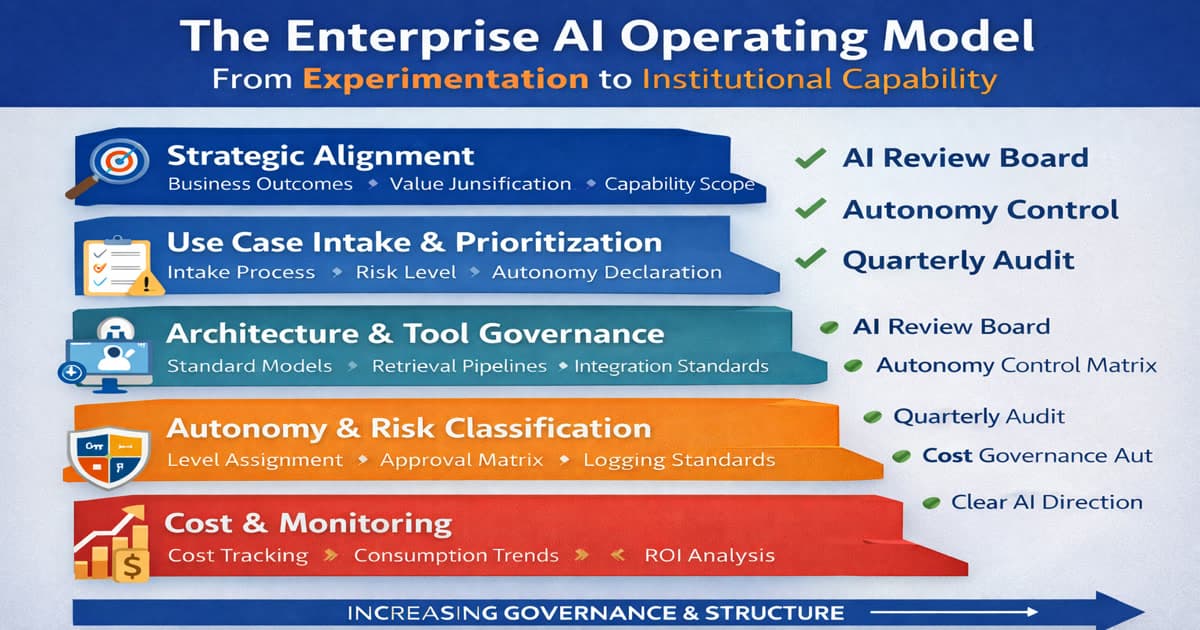
- Governance
Enterprise AI requires:
- Formal use case intake
- Autonomy approval matrix
- Cost-per-workflow tracking
- Architecture review integration
- AI review board oversight
- Quarterly structural audits
Risk Level: Controlled
AI is no longer a feature.
It is a platform capability.
Horizontal Growth vs Vertical Control
AI evolves horizontally:
Direct Model → + Context → + Action → + Orchestration
Governance must evolve vertically:
Policy
→ Data Control
→ Tool Boundaries
→ Platform Governance
If horizontal growth outpaces vertical control, instability follows.
Check your own systems: the interactive AI Evolution Stack check places each one at its level and lists the controls it is missing.
Implementation Roadmap (90 Days)
Phase 1: Classification (Weeks 1--3)
- Map each AI system to its evolution level
- Identify autonomy exposure
- Document integrations
Phase 2: Standardization (Weeks 4--8)
- Standardize retrieval architecture
- Define tool exposure rules
- Introduce escalation checkpoints
- Establish logging
Phase 3: Institutionalization (Weeks 9--12)
- Introduce AI review board
- Implement cost dashboards
- Integrate AI into architecture governance
- Conduct structural audit
Final Thought
AI complexity is inevitable.
Instability is optional.
Model capability grows fast.
Action grows faster.
Governance must grow fastest.
AI transformation succeeds when structural maturity keeps pace with
intelligence.
Evidence from Practice
A FinTech I worked with had AI systems at three different maturity levels simultaneously: a chatbot using prompt engineering (Level 1), a fraud detection model with context windows (Level 2), and an agent that could execute trades within parameters (Level 3). Each was governed the same way — which meant none was governed appropriately. The Level 1 system had too much process. The Level 3 agent had too little.
We classified each AI system against the evolution stack, identified the governance model appropriate for each maturity level, and implemented controls proportionate to autonomy. The Level 3 agent required human-in-the-loop confirmation for trades above a threshold. The Level 1 chatbot required none. The governance burden dropped by half, and the risk exposure dropped further.
The AI operating model that enabled this classification is detailed here: From 15 AI Pilots to 6 Prioritized Initiatives
Ensure Governance Matures as Fast as Intelligence
If your AI systems are evolving from simple prompts to agents…
if action capability is expanding across workflows…
or if orchestration is growing faster than oversight —
complexity is increasing.
The question is whether control is keeping pace.
In a focused 30-minute AI Maturity Diagnostic, we will:
- Classify your AI initiatives across Basic, Contextual, Agentic, and Enterprise stages
- Identify where horizontal capability growth exceeds vertical governance control
- Evaluate autonomy exposure and cost volatility
- Define the structural controls required before the next maturity jump
No experimental sprawl.
No unchecked autonomy expansion.
No platform chaos.
Just structural clarity aligned to AI maturity.
→ Book an AI Evolution Strategy Session
or
AI maturity is not about smarter models.
It is about stronger structure.