Search

Find insights, training programs, and workshops

Review Forums & Decision Authority
Intermediate (SA, EA, TS)3-4 hoursArchitecture board design guide + review charter template + decision rights matrix

How to design, run, and improve architecture review forums — the structured spaces where decisions are evaluated, challenged, approved, and communicated.

...here — Why reviews exist Types of review Who sits in which forum Running effective reviews Decision authority Technical leadership groups Common failure modes Putting it all together Cheat sheet Before...

Half-dayIntensive
PracticalSA · EA · TS
Architecture Communication & Storytelling
Intermediate to Advanced (SA, EA, TS)5-6 hoursArchitecture communication playbook + executive presentation template + workshop facilitation guide

How to communicate architecture decisions so they are understood, adopted, and acted on — covering audience adaptation, executive communication, architecture papers, diagrams, workshop facilitation, and influence without authority.

...executives Writing architecture papers Architecture diagrams Facilitating workshops Influence without authority Putting it all together Cheat sheet Before we start — the one thing to hold onto Architecture...

1 DayIntensive
CriticalSA · EA · TS
AI Decision-Making & Human Oversight
Beginner to Intermediate3-4 hoursHuman oversight framework + decision rights map + review checklist

AI can assist decisions, but accountability still belongs to people. Learn the operating rules for review, approval, escalation, confidence, and human authority in AI-supported work.

...Navigation Before we start — the oversight mistake everyone makes The control principle Assistance is not authority Levels of human oversight Decision support vs decision delegation Confidence, escalation, and...

Half DayPractical
Control ModelDecision Ready
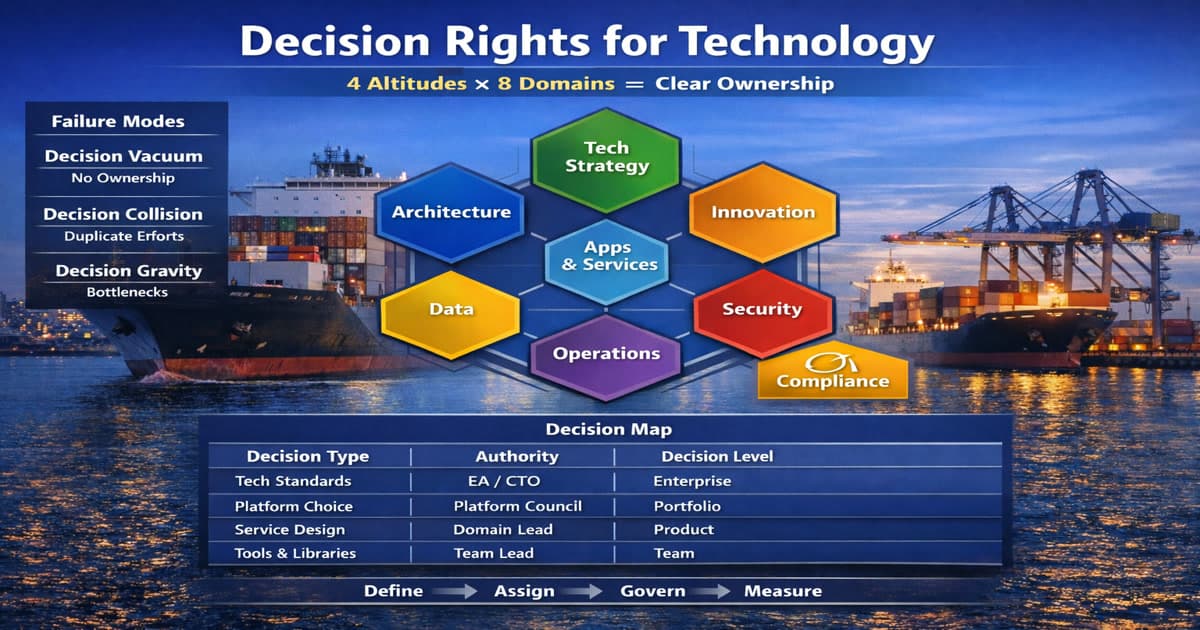
Decision Rights for Technology — Who Decides What in a Modern Enterprise

Why most enterprises confuse escalation ladders with decision rights — and how Technology Decision Domain Architecture maps exactly who decides what, at which altitude, before the conflict arrives.

...Engineering Directors Problem it solves: Technology decisions stall, duplicate, or collide because authority is assumed rather than assigned Key outcome: A structured model that maps decision rights by...

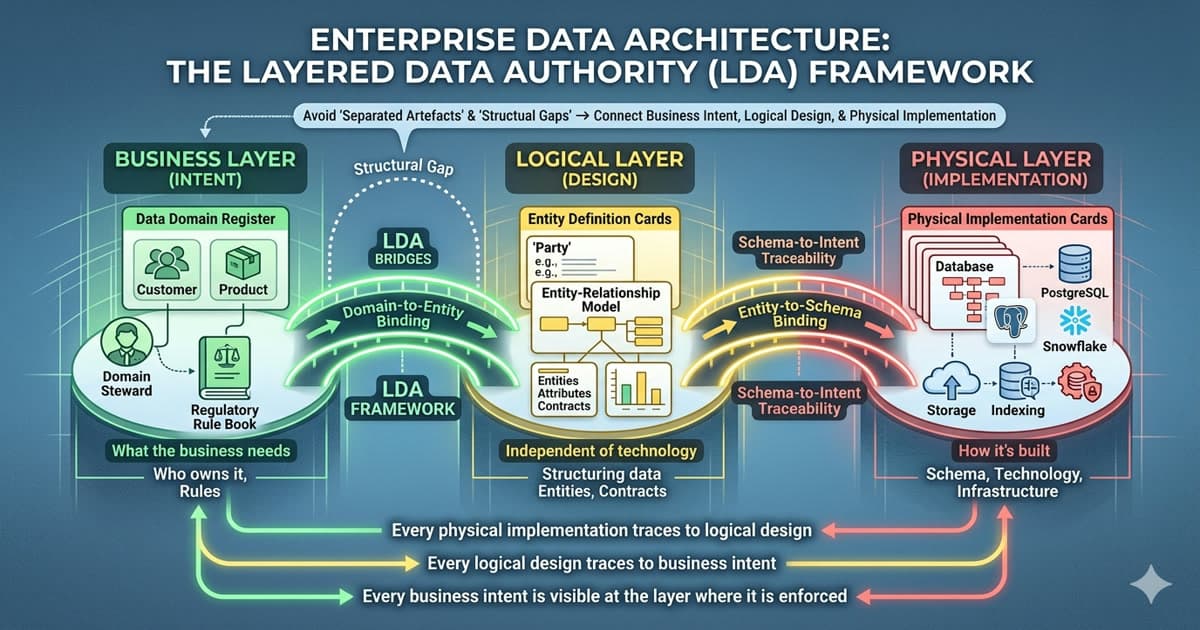
Complete Enterprise Data Architecture Framework: Business, Logical, Physical Layers with Real Templates

Most enterprises build data architectures one layer at a time. Business, logical, and physical layers exist as separate artefacts owned by separate teams. That separation is the structural gap that makes data estates ungovernable.

...different tools, with no connecting model Key outcome: A coherent three-layer framework called Layered Data Authority (LDA) that connects business intent, logical design, and physical implementation into a single...

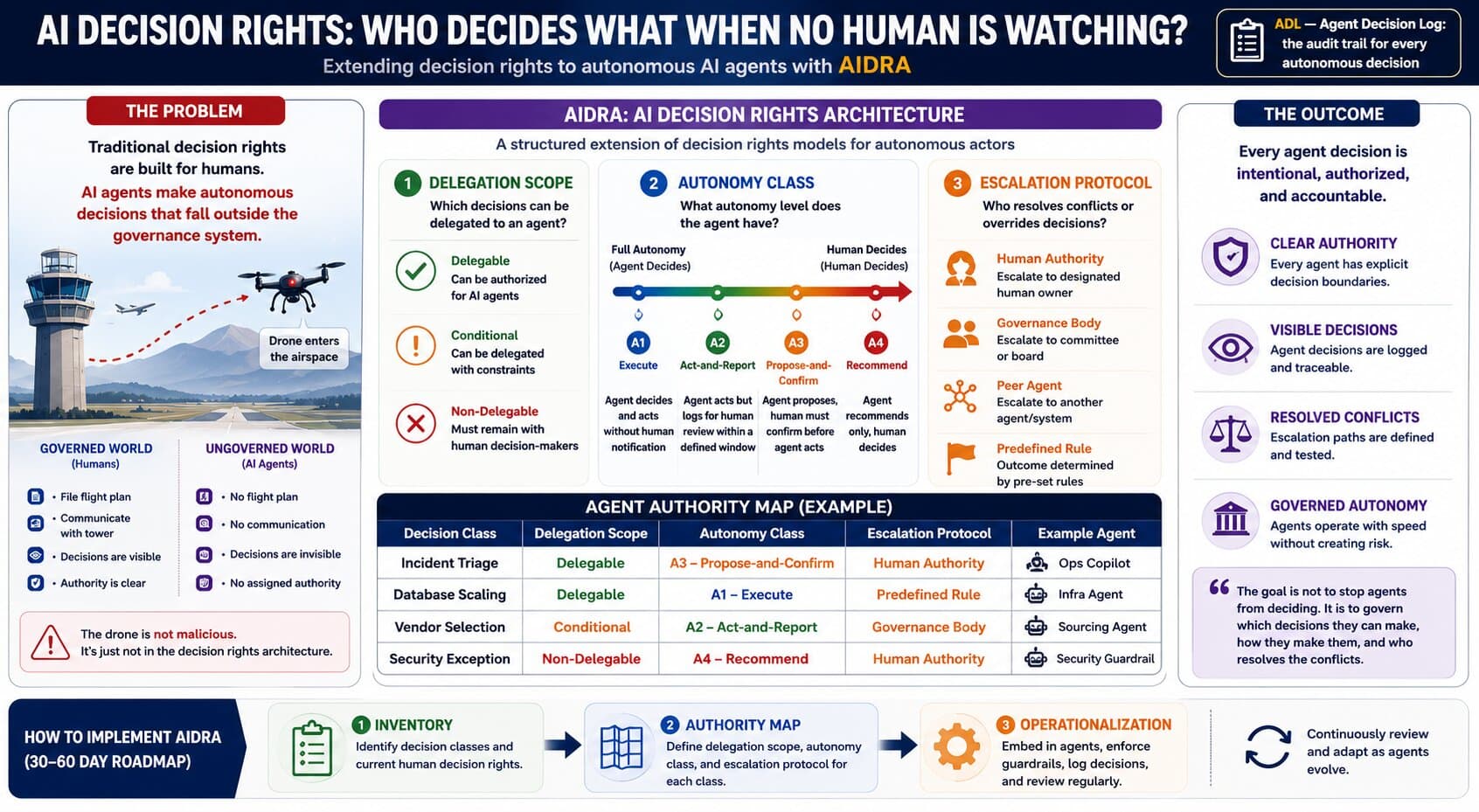
AI Decision Rights: Who Decides What When No Human Is Watching?

Decision rights models assume human decision-makers. AI agents breach that assumption silently. Here is how to extend decision rights to cover autonomous actors before the first ungoverned decision becomes a production incident.

...AI Decision Rights Architecture (AIDRA) — an extension of standard decision rights models that maps authority for autonomous actors across three dimensions: delegation scope, autonomy class, and escalation...

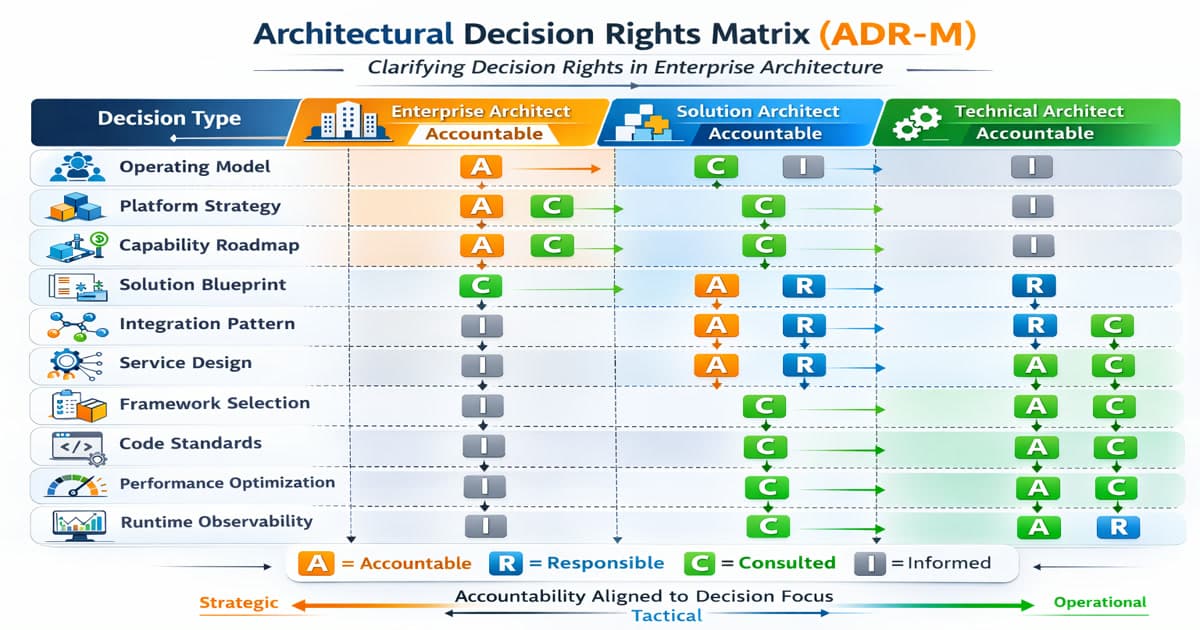
Architectural Decision Rights Matrix: Governing Enterprise, Solution, and Technical Architecture

A governance framework introducing the Architectural Decision Rights Matrix (ADR-M) to clarify accountability between Enterprise, Solution, and Technical Architects in Context-Driven Architecture.

...Architecture Governance Leaders Problem it solves: Architectural role confusion leading to duplicated authority, governance friction, and structural instability Key outcome: A codified Architectural Decision...

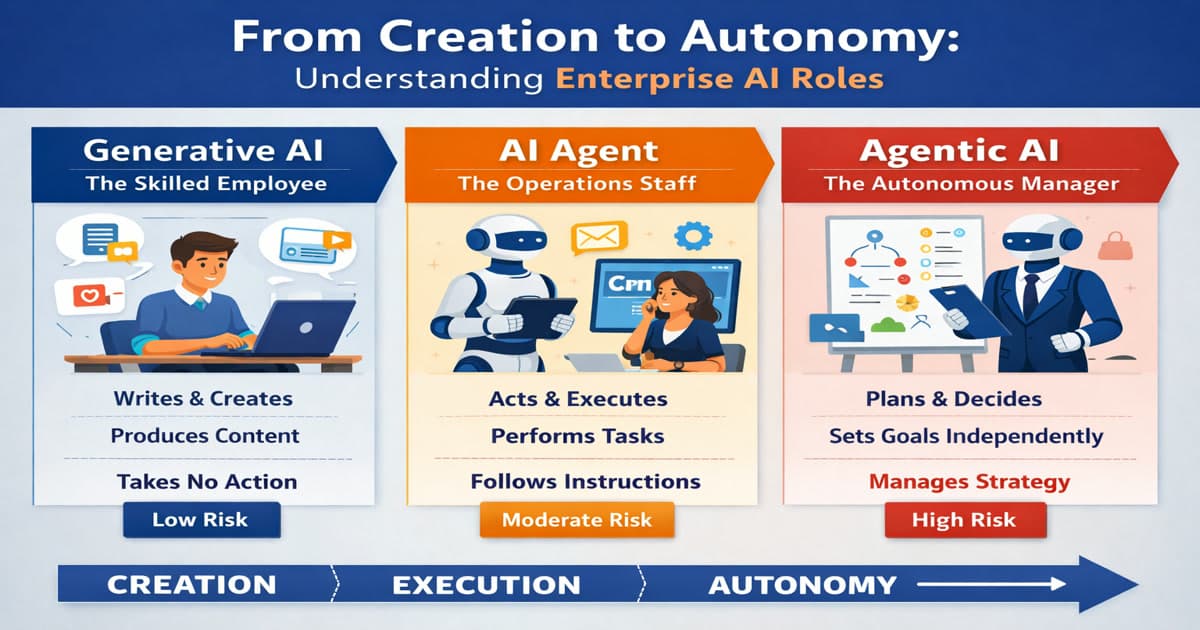
From Creation to Autonomy: Understanding Generative AI, AI Agents, and Agentic AI Through a Workplace Analogy

A clear executive guide explaining Generative AI, AI Agents, and Agentic AI using a corporate office analogy to prevent autonomy risks in enterprise AI.

...used interchangeably. They are not the same. The difference is not intelligence. The difference is authority and autonomy. To understand this clearly, imagine your company as an office. The Corporate...

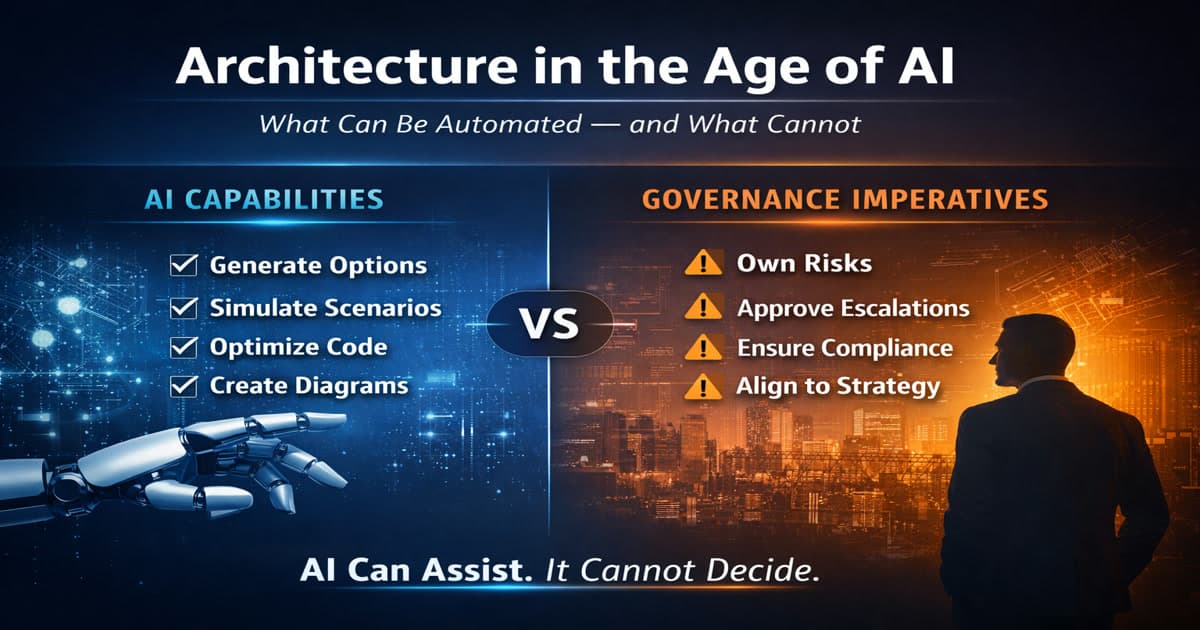
Architecture in the Age of AI: What Can Be Automated — and What Cannot

A governance-driven perspective explaining why software architecture cannot be automated because decision accountability and consequence ownership cannot be delegated to AI.

...effort. They increase option visibility. They compress design cycles. But none of these functions require authority. They require analysis. Architecture requires more than analysis. The Mechanical Layer vs The...

Decision Velocity Is Not a Leadership Problem. It Is an Architecture Problem.

Decision velocity is not constrained by leadership intent but by architectural design. Governance systems built for slower eras create mechanical delay between insight and execution.

...just inherited architecture. The Mechanical Causes of Delay Approval layers create waiting because authority is unclear or duplicated Governance checkpoints slow down decisions because they operate in...