Skip to content

Search

Find insights, training programs, and workshops

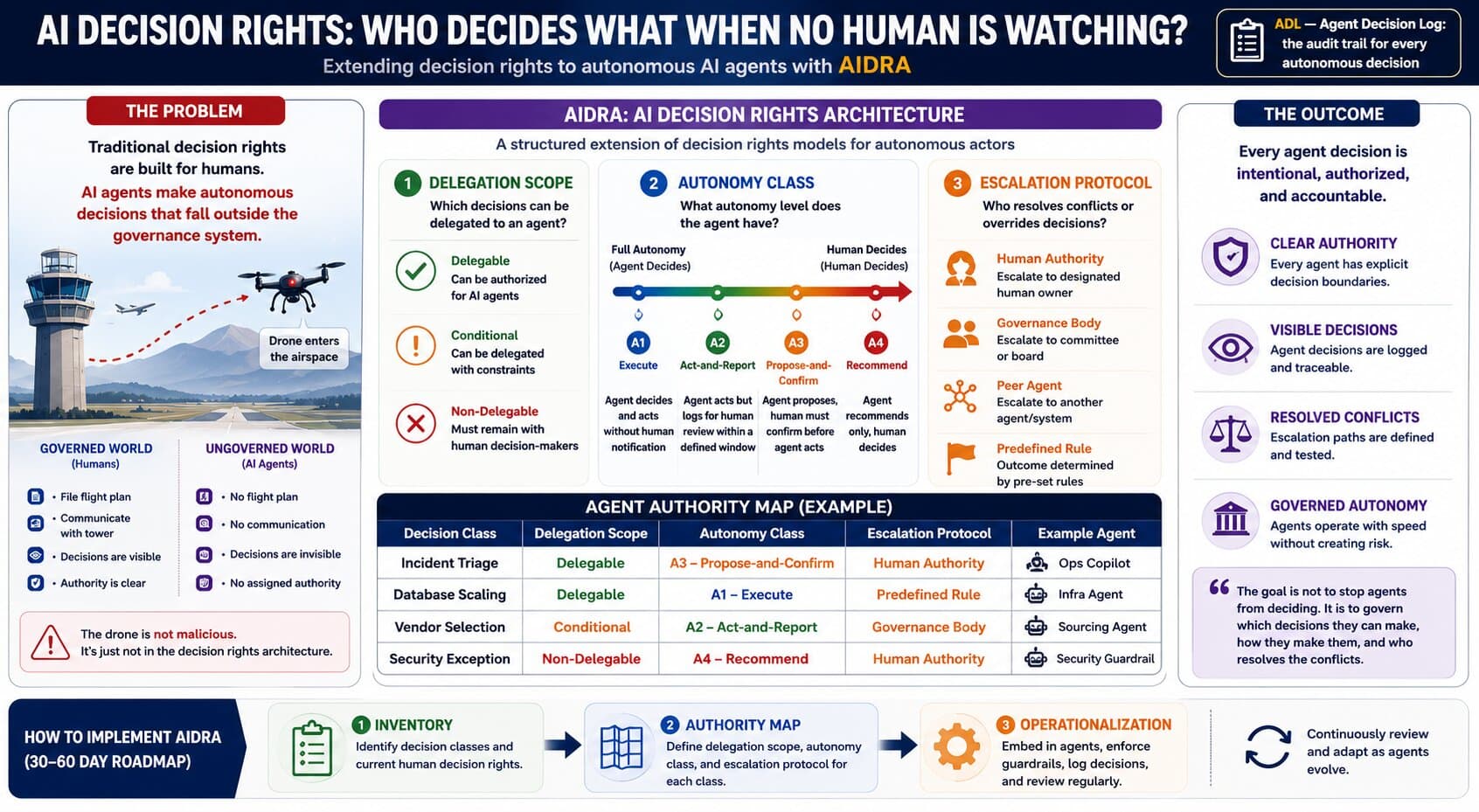
AI Decision Rights: Who Decides What When No Human Is Watching?

Decision rights models assume human decision-makers. AI agents breach that assumption silently. Here is how to extend decision rights to cover autonomous actors before the first ungoverned decision becomes a production incident.

...Assume Human Actors Decision rights models assign authority to people. Enterprise architects decide platform standards. Domain architects decide integration contracts. Engineering leads decide implementation...

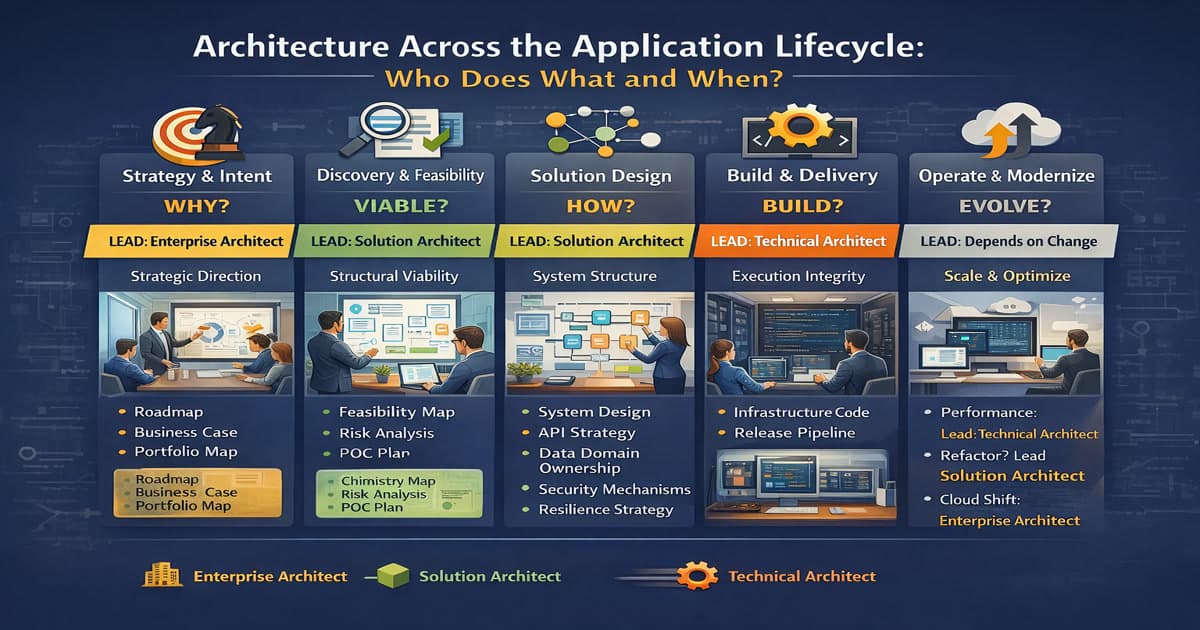
Architecture Across the Application Lifecycle: Which Architect Is Needed When?

A practical guide explaining which type of architect is required at each stage of the application lifecycle to prevent governance friction and structural instability.

...Stage Core Question Why are we building this? Typical Decisions Build vs Buy Capability alignment Platform reuse Portfolio positioning Funding allocation Risk appetite Primary Architectural Owner Enterprise...

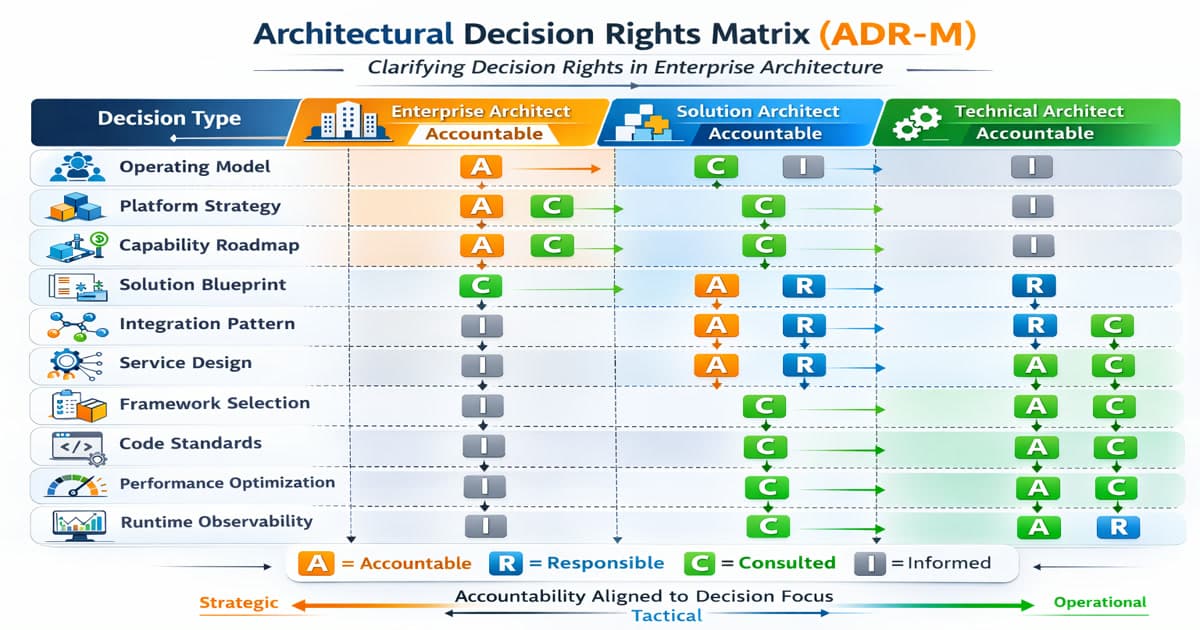
Architectural Decision Rights Matrix: Governing Enterprise, Solution, and Technical Architecture

A governance framework introducing the Architectural Decision Rights Matrix (ADR-M) to clarify accountability between Enterprise, Solution, and Technical Architects in Context-Driven Architecture.

...decision altitude clarity. Enterprise Architects debate frameworks. Solution Architects redefine platform strategy. Technical Architects override structural principles. Roles exist. Authority boundaries...

Current State & Target State Architecture
All levels — SA, EA, TS4-5 hoursAs-is / to-be architecture canvas + transition state design + maturity scale + AI readiness assessment

How to document what exists today, define what must exist tomorrow, and design the transition states that get you there — the discipline of architecture that connects present reality to future goals.

...the messy present and go straight to the clean target state. When current state isn't documented, teams design solutions that ignore existing constraints — integration debt, legacy dependencies, data...

1 dayIntensive
PracticalCanvas exercise
Quality Attributes / -ilities
SA, EA — Intermediate5-6 hoursQuality attribute reference card + -ility prioritisation matrix

The non-functional characteristics that determine whether a system is truly fit for purpose — scalability, reliability, availability, performance, security, maintainability, and more.

...under load, takes 30 seconds to respond, or exposes customer data isn't fit for purpose. I've seen teams build systems that do the right things — but do them slowly, unreliably, or insecurely. Quality...

1 DayIntensive
SA · EARoles
Technology Strategy & Architecture Strategy
Advanced (EA, TS)5-6 hoursTechnology strategy vs architecture strategy distinction map + strategy brief template

How to distinguish technology strategy from architecture strategy, connect both to business strategy, and define a coherent direction for the organisation's technology investments.

...strategy. They have architecture diagrams but not architecture strategy. They invest in cloud, AI, and platforms because everyone else is — not because a deliberate analysis connected those investments to...

1.5 DaysIntensive
StrategicEA · TS
Investment & Prioritisation
Advanced (EA, TS)5-6 hoursInvestment prioritisation model + business case guide (including TCO and unit economics) + sequencing criteria

How to decide which technology initiatives get funded, in what order, and why — connecting architecture to financial decisions and business outcomes.

...sheet Before we start — the one thing to hold onto Not every good idea can be funded. Budgets are finite, teams are finite, and attention is finite. I've seen investment decisions made on political power, whoever...

1 DayIntensive
StrategicEA · TS
What Architecture Is
All levels — SA, EA, TS3-4 hoursArchitecture definition canvas + what it is / what it isn't reference card

What software and enterprise architecture actually is — its structure, relationships, and decisions — and what it is not. No diagrams. No jargon. Just clarity.

...Even the ones nobody drew. Even the ones that grew organically over five years with twelve different teams touching the codebase. The structure is there. The relationships are there. The decisions are there...

Half-dayIntensive
FoundationFor all roles
Portfolio & Dependency Thinking
All levels — SA, EA, TS4-5 hoursPortfolio map template + dependency radar + investment alignment grid

How to see all systems, initiatives, and investments as a connected whole — understanding dependencies, shared capabilities, and how decisions in one place ripple across others.

...don't exist in isolation. They're part of a portfolio — a connected collection of systems, programmes, platforms, and investments. Decisions made about one system ripple across others. An investment in one...

1 dayIntensive
StrategicPortfolio-level
Decision Rights & Delegation
Engineering Managers, Tech Leads, Directors, CTO, VP Engineering3-4 hoursDecision rights map by altitude and domain, with every gap, overlap and delay node named

Decisions made at the wrong altitude are the commonest source of both bottleneck and drift — which makes delegation a design problem, not a trust problem.

...consistently. Decision Vacuum. Nobody is certain who holds authority for a class of decision, so nobody decides. Teams wait. Delivery stalls. The work technically belongs to someone — but nobody wants to claim a decision...

1 DayIntensive
AltitudeWho decides what
1···456···8