The Real Problem Is Not Role Confusion — It’s Timing Confusion
Most organizations define architectural roles.
Few define when each role should lead.
As a result:
- Enterprise Architects review API design.
- Solution Architects are absent during discovery.
- Technical Architects are brought in after structural decisions are frozen.
- Modernization efforts escalate without altitude clarity.
Architecture does not fail because roles are undefined.
It fails because architectural leadership does not shift correctly across the application lifecycle.
The Five Practical Lifecycle Stages
Every application — whether startup or enterprise — passes through five functional stages:
- Strategy & Intent
- Discovery & Feasibility
- Solution Design
- Build & Delivery
- Operate, Scale & Modernize
These stages exist everywhere.
The depth of governance may vary.
But the architectural inflection points do not.
1. Strategy & Intent Stage
Core Question
Why are we building this?
Typical Decisions
- Build vs Buy
- Capability alignment
- Platform reuse
- Portfolio positioning
- Funding allocation
- Risk appetite
Primary Architectural Owner
Enterprise Architect
Why?
This stage determines structural direction.
Mistakes here create strategic misalignment and redundant investment.
Who Should Not Lead Here
Technical Architects should not define platform posture.
Solution Architects should not redefine operating model.
Altitude must be respected.
2. Discovery & Feasibility Stage
Core Question
Is this initiative structurally viable?
Typical Decisions
- New capability or extension?
- Integration complexity
- Regulatory implications
- Data sensitivity
- Non-functional risk estimation
Primary Architectural Owners
Enterprise Architect (strategic guardrails)
Solution Architect (structural feasibility)
Role of Technical Architect
Consulted for early feasibility risks.
Risk of Failure
Underestimated complexity and structural instability downstream.
3. Solution Design Stage
Core Question
How should this system be structured?
Typical Decisions
- Service boundaries
- Domain partitioning
- Integration patterns
- Data ownership
- Resilience model
- Security architecture
Primary Architectural Owner
Solution Architect
Why?
This stage translates enterprise climate into system structure.
Enterprise defines constraints.
Technical ensures feasibility.
But structural ownership sits with Solution.
Risk of Failure
Integration sprawl.
Duplicate capabilities.
Long-term instability.
4. Build & Delivery Stage
Core Question
Is the system implemented correctly?
Typical Decisions
- Framework selection
- Code structure
- Dependency rules
- CI/CD design
- Observability implementation
- Performance optimization
Primary Architectural Owner
Technical Architect
Why?
Execution integrity determines runtime stability.
Solution ensures blueprint alignment.
Enterprise should not intervene unless structural deviation occurs.
Risk of Failure
Technical debt.
Fragility.
Production instability.
5. Operate, Scale & Modernize Stage
Core Question
How does this system evolve safely?
This stage is not static.
Architectural ownership depends on the altitude of change.
If Performance Optimization:
→ Technical Architect leads.
If Structural Refactoring:
→ Solution Architect leads.
If Platform Shift / Cloud Migration:
→ Enterprise Architect leads.
This is where many organizations fail.
They treat modernization as purely technical.
But modernization often requires altitude reassessment.
Lifecycle Ownership Matrix
| Lifecycle Stage | Enterprise Architect | Solution Architect | Technical Architect |
|---|---|---|---|
| Strategy | Primary | Consulted | Informed |
| Discovery | Primary | Primary | Consulted |
| Design | Consulted | Primary | Responsible |
| Build | Informed | Consulted | Primary |
| Operate / Modernize | Depends on altitude of change |
Architectural leadership shifts over time.
It is not static.
The Hidden Cost of Getting This Wrong
When architectural altitude does not shift correctly:
- Enterprise over-governs execution
- Solution bypasses enterprise guardrails
- Technical redefines structural decisions
- Modernization escalates into strategic drift
Governance friction increases.
Delivery slows.
Confidence declines.
Implementation Guide (30 Days)
Phase 1: Lifecycle Mapping (Weeks 1–2)
- Document your organization’s application lifecycle stages
- Map current architectural involvement
- Identify overreach or absence
- Clarify primary ownership per stage
Success Metric: No stage without a clearly defined architectural lead
Phase 2: Engagement Model Alignment (Weeks 3–4)
- Formalize lifecycle engagement model
- Define escalation rules for cross-altitude changes
- Communicate role shifts across delivery teams
- Align architecture review checkpoints to lifecycle stages
Success Metric: Reduced cross-role conflict and faster architectural decisions
Evidence from Practice
A SaaS company I worked with had Enterprise Architects reviewing database schema changes and Technical Architects making platform-level decisions that affected every team. The wrong architects were engaged at the wrong stages — the lifecycle stage dictated the need, but the organisation had a one-size-fits-all architect assignment model.
We mapped their application lifecycle stages against the architect type needed at each stage. Enterprise Architects focused on discovery and strategy. Solution Architects owned design and delivery. Technical Architects governed implementation and operations. The shift did not require new hires — it required reassigning existing architects to the stages where their skills were needed. Architecture review quality improved. Architect burnout decreased.
Action Plan
This Week:
- Map your application lifecycle stages.
- Identify which architect currently dominates each stage.
- Ask: Is this the correct altitude?
If not, adjust ownership.
Final Thought
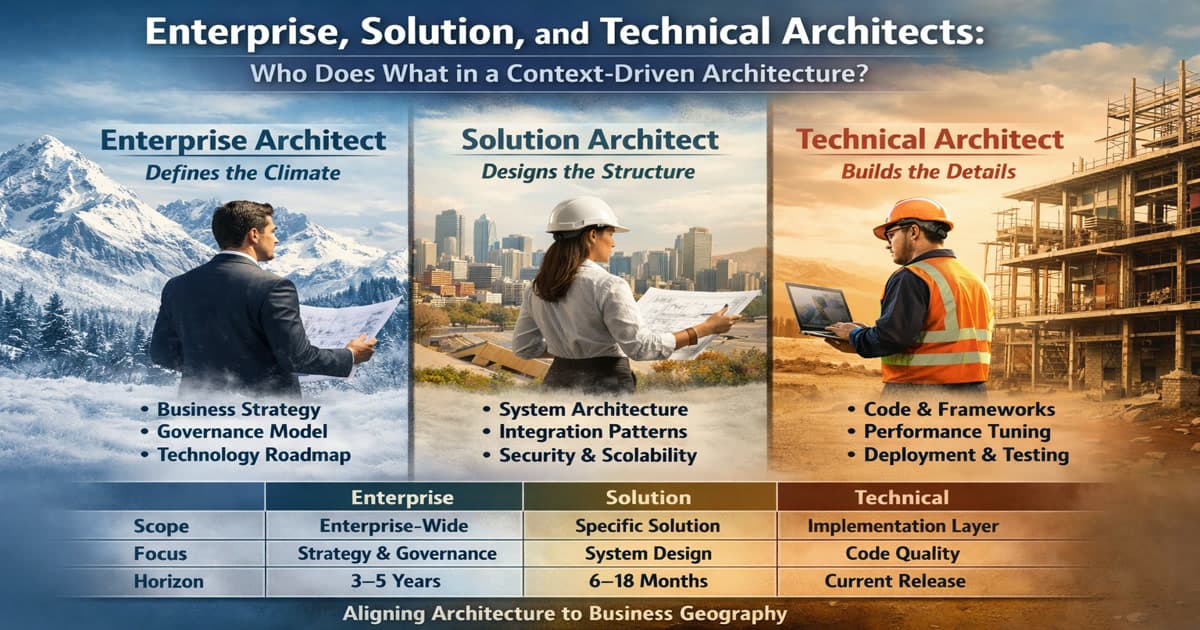
Architecture is not just about roles.
It is about when those roles lead.
Enterprise defines intent.
Solution defines structure.
Technical ensures execution integrity.
Leadership shifts across the lifecycle.
When altitude aligns with stage, execution accelerates.
When it does not, friction compounds.
Architecture succeeds not only because of clarity of responsibility —
but because of clarity of timing.
Align Architectural Altitude to Lifecycle Stage
If Enterprise Architects are reviewing code…
if Solution Architects are absent during discovery…
or if modernization efforts escalate without strategic reassessment —
you do not have a role definition problem.
You have a timing misalignment problem.
In a focused 30-minute Architecture Lifecycle Alignment Diagnostic, we will:
- Map your application lifecycle stages against current architectural ownership
- Identify altitude overreach or absence across stages
- Detect governance friction caused by mis-timed leadership
- Define a clear engagement model aligned to lifecycle inflection points
No additional review boards.
No political restructuring.
No theoretical role diagrams.
Just structural clarity on who should lead — and when.
→ Book an Architecture Lifecycle Alignment Session
or
Architecture succeeds when altitude aligns with timing.