Search

Find insights, training programs, and workshops

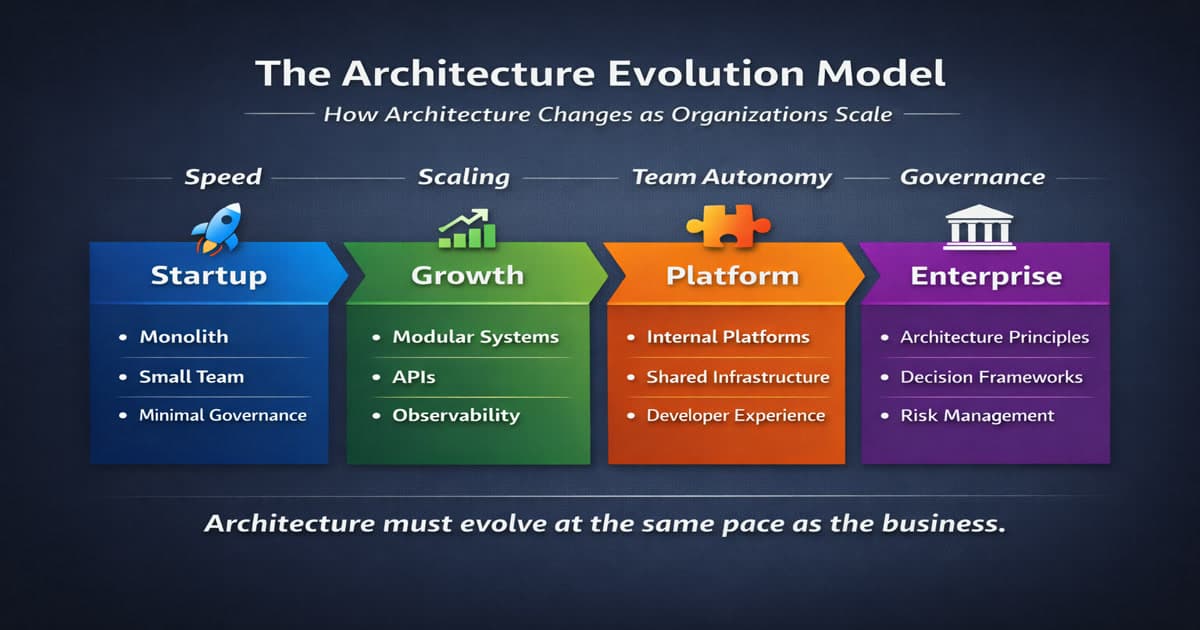
The Architecture Evolution Model: How Architecture Changes from Startup to Enterprise

A practical framework explaining how software architecture evolves from startup experimentation to enterprise-scale governance, and what architectural practices are needed at each stage.

...product-market fit. Example A startup building a SaaS platform might begin with: Single backend service Single database Cloud deployment Simple CI/CD pipeline This is entirely appropriate. Overengineering at this...

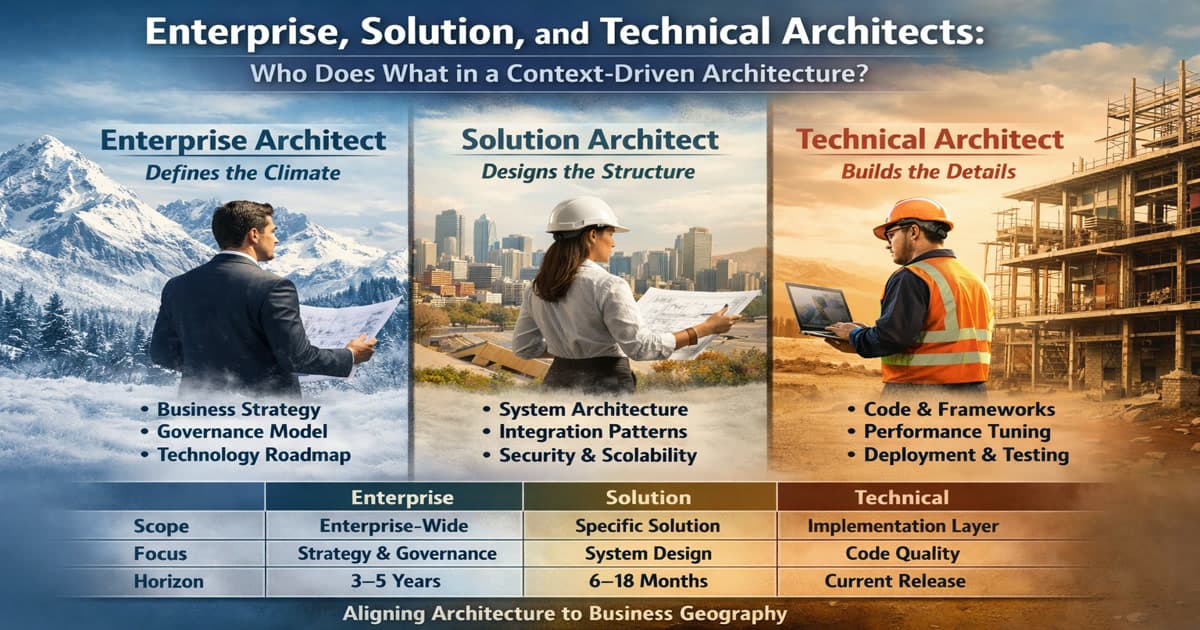
Context-Driven Architecture: Why Software Design Must Adapt to Business Geography

Just as buildings must adapt to snow, desert, or tropical climates, software architecture must align with business geography to improve predictability and reduce complexity.

...fluctuating? Are seasonal spikes extreme? Is regulatory change frequent? Is experimentation central to strategy High volatility demands elasticity and decoupling. Stable climates reward simplicity and cost...

AI Procurement, Vendor Evaluation & Tool Selection
Beginner to Intermediate3-4 hoursVendor evaluation scorecard + tool selection checklist + risk review template

Choosing AI tools is not a beauty contest. Learn how to evaluate vendors, compare capabilities, assess risk, avoid lock-in, and buy systems that your organisation can actually govern and adopt.

...for what is easiest to show. You need to evaluate what is easiest to hide. That includes: privacy and data handling access controls and logging configuration flexibility integration requirements cost behaviour...

Half DayDecision Focused
Vendor SelectionPractical
AI Use Case Discovery & Prioritization
Beginner to Intermediate4-5 hoursAI use case portfolio + prioritisation matrix + pilot shortlist

The hardest AI question is often not how to build, but what to build first. Learn how to find real use cases, assess fit, sequence experiments, and avoid expensive distractions.

...the problem clearly defined? Is the task something AI is genuinely good at? Is the needed context or data accessible? Can adoption be imagined in a real workflow? Could success be measured in under 90 days?...

1 DayWorkshop
Portfolio DesignPractical
AI Operating Model Workshop
CTO, CIO, VP Engineering, Enterprise Architects, AI LeadersAI ownership model, governance framework, capability map, 90-day activation plan

Stop running AI experiments in isolation. Build the ownership structure, governance model, and decision rights that turn scattered AI pilots into an organisation-wide capability.

...building the models. CTO, CIO, Chief AI Officer VP Engineering, VP Product Enterprise Architects and AI Strategy Leads Business Unit Leaders responsible for AI adoption Typical team size: 6-10 participants Format:...

1 DayIntensive
Clear OwnershipAI at Scale
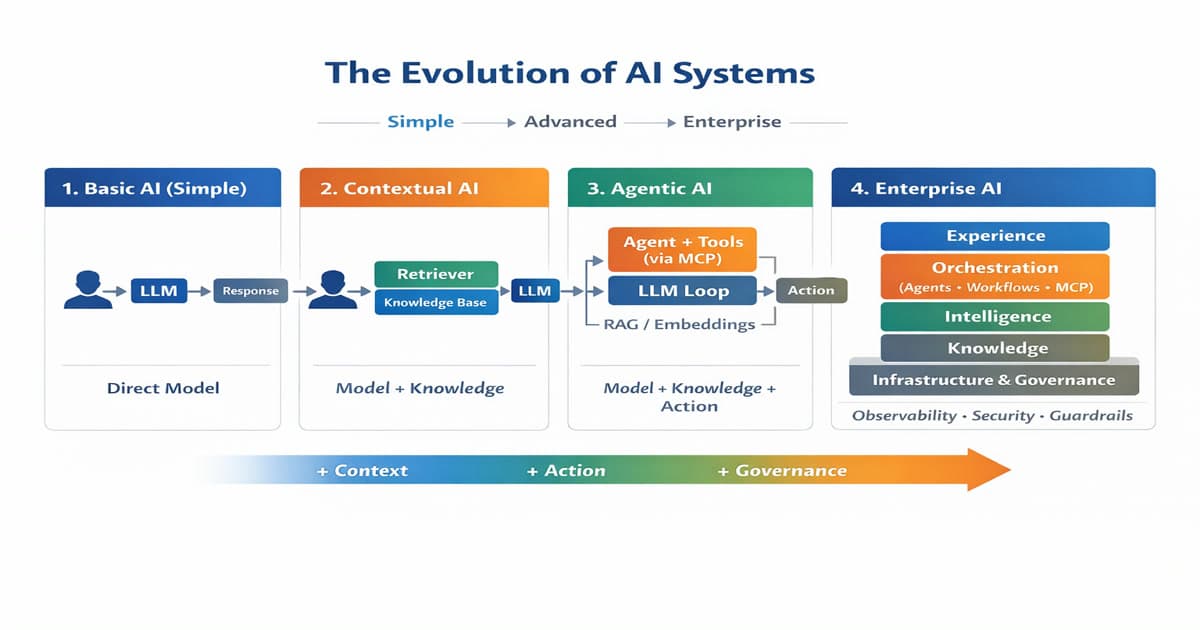
MCP Is Not an AI Protocol. It Is a Governance Layer.

MCP is classified as an AI integration protocol. It is actually a governance primitive — the stable interface layer that architecture fitness functions have been missing for years.

...and a provider that holds the answers. The consumer does not need to know how the provider stores its data. The consumer does not need to know how the provider's internal structure is organised. The consumer...

The Minimum Architecture Every Company Needs: The House, the Hallway, and the Doorbell

A practical architectural model explaining why most companies only need a modular monolith, a workflow orchestrator, and outcome-based events.

...module boundaries Shared runtime environment Internal communication through direct calls Consistent data model This structure reduces: network latency operational complexity deployment coordination Most...

Decision Rights for Technology — Who Decides What in a Modern Enterprise

Why most enterprises confuse escalation ladders with decision rights — and how Technology Decision Domain Architecture maps exactly who decides what, at which altitude, before the conflict arrives.

...standards Domain Decisions that govern a bounded business or technology domain Domain platform choices, data ownership rules, integration contracts Team Decisions within a team's implementation boundary Library...

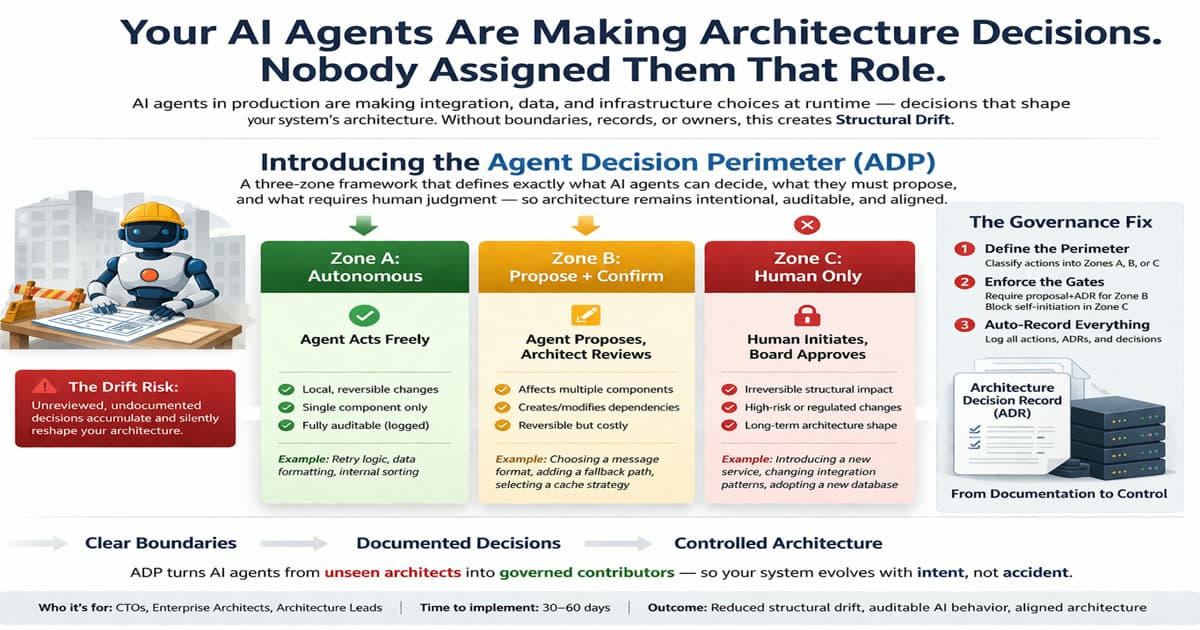
AI Decision Rights: Who Decides What When No Human Is Watching?

Decision rights models assume human decision-makers. AI agents breach that assumption silently. Here is how to extend decision rights to cover autonomous actors before the first ungoverned decision becomes a production incident.

...constrained. Over time, as trust grows, the constraints loosen informally. The agent gains access to new data sources, new action types, and new decision domains. Without a recorded autonomy class, there is...

Nobody Uses ADRs as an Agentic Decision Log. They Should.

Why Architectural Decision Records are the only structure most organizations already have that can govern AI agent accountability — and how to extend them into an Agentic Decision Log before the EU AI Act deadline.

...Examples include: agents making financial decisions above defined thresholds agents processing personal data agents routing or triaging customer interactions agents generating content published without human...