Search

Find insights, training programs, and workshops

The AI Evolution Stack: How AI Systems Mature from Simple Models to Governed Platforms

A structured guide explaining how AI systems evolve from simple model usage to governed platforms, and how to scale complexity without losing architectural control.

...evolution model --- Simple → Contextual → Agentic → Enterprise Time to implement clarity: 60--90 days Business impact: Reduced instability, predictable cost growth, controlled autonomy expansion The Evolution...

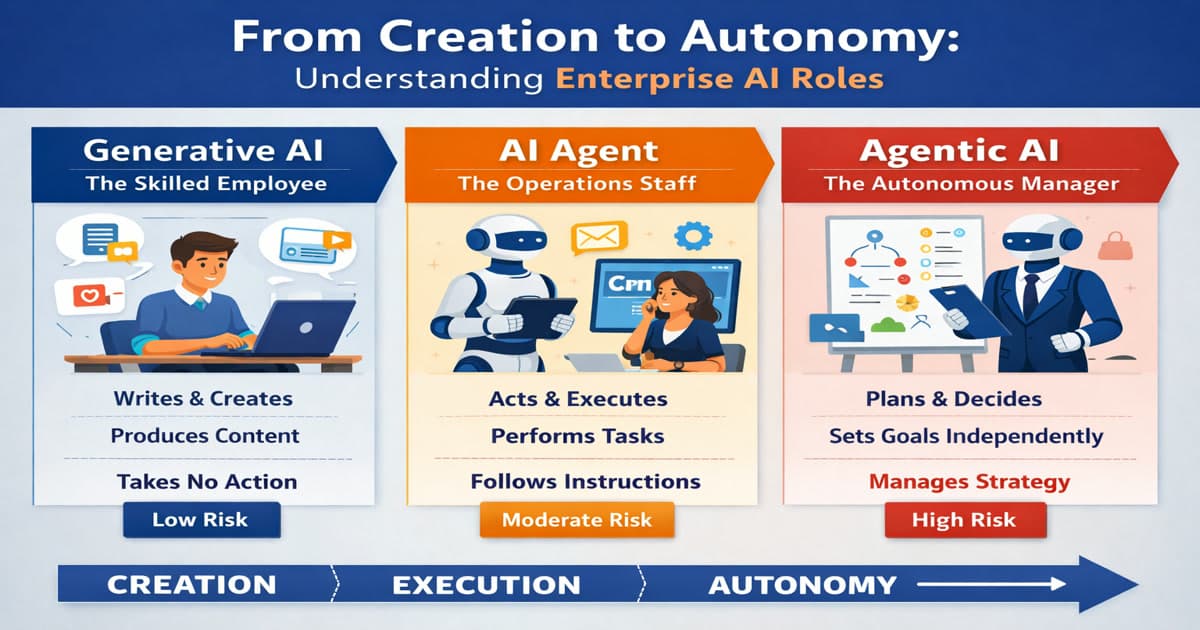
The Enterprise AI Operating Model: From Experimentation to Institutional Capability

A structured executive guide explaining how to move from AI experimentation to an Enterprise AI Operating Model with governance, autonomy control, and cost discipline.

...without governance or structural clarity Key outcome: A practical framework to institutionalize AI across strategy, architecture, autonomy, and cost control Time to implement: 60–90 days Business impact: Reduced...

How Architects Think
All levels — SA, EA, TS5-6 hoursSystems thinking toolkit + abstraction ladder + decision heuristics reference card

The cognitive toolkit of architecture — systems thinking, abstraction, balancing business and technical concerns, deciding under uncertainty, and trade-off thinking. Builds the mindset, not just the knowledge.

...but could tell you exactly what would break if you changed it. Architects think in systems — holding business and technical concerns simultaneously, making decisions under uncertainty, and choosing trade-offs...

1 DayIntensive
MindsetNot just methods
Security Is Not a Gate. It Is an Architecture Property.

Security is treated as a gate at the end of delivery. It should be an architecture property designed into three distinct boundaries. Here is the model that fixes the friction between security and delivery.

...the level where they can be made accurately, quickly, and accountably Time to implement: 60–90 days Business impact: Security reviews get faster, delivery velocity increases, and the security posture becomes...

AI Architecture Clarity: Understanding LLM, RAG, Agents, and MCP Through the Brain Model

A clear executive guide explaining LLM, RAG, AI Agents, and MCP using the Brain model to prevent enterprise AI instability.

...sprawl, improved governance control Time to implement: 60–90 days for structured AI capability alignment Business impact: Lower experimentation waste, controlled cost growth, safer AI scaling The Enterprise...

Architecture in the Age of AI: What Can Be Automated — and What Cannot

A governance-driven perspective explaining why software architecture cannot be automated because decision accountability and consequence ownership cannot be delegated to AI.

...outcome: Clear distinction between mechanical design and decision governance Time to implement: 30–60 days Business impact: Protects structural stability in an AI-accelerated environment The Question Everyone...

Execution Stability: How Structured Refactoring Improves Delivery Predictability

A practical framework for reducing delivery slowdown caused by unmanaged structural code complexity — improving cycle time, reducing regression risk, and clarifying ownership boundaries.

...improved cycle time, clearer ownership boundaries Time to implement: 60–90 days for structured rollout Business impact: Higher engineering throughput without increasing headcount The Silent Slowdown in Growing...

The Capability Map That Cannot Answer a Question Is Not a Capability Map

Why traditional capability maps fail to support governance decisions and how Queryable Capability Architecture turns static maps into interrogable decision systems.

...architecture intelligence Time to implement: 30–60 days to build a structured queryable capability model Business impact: Better governance decisions, clearer ownership visibility, reduced technology duplication,...

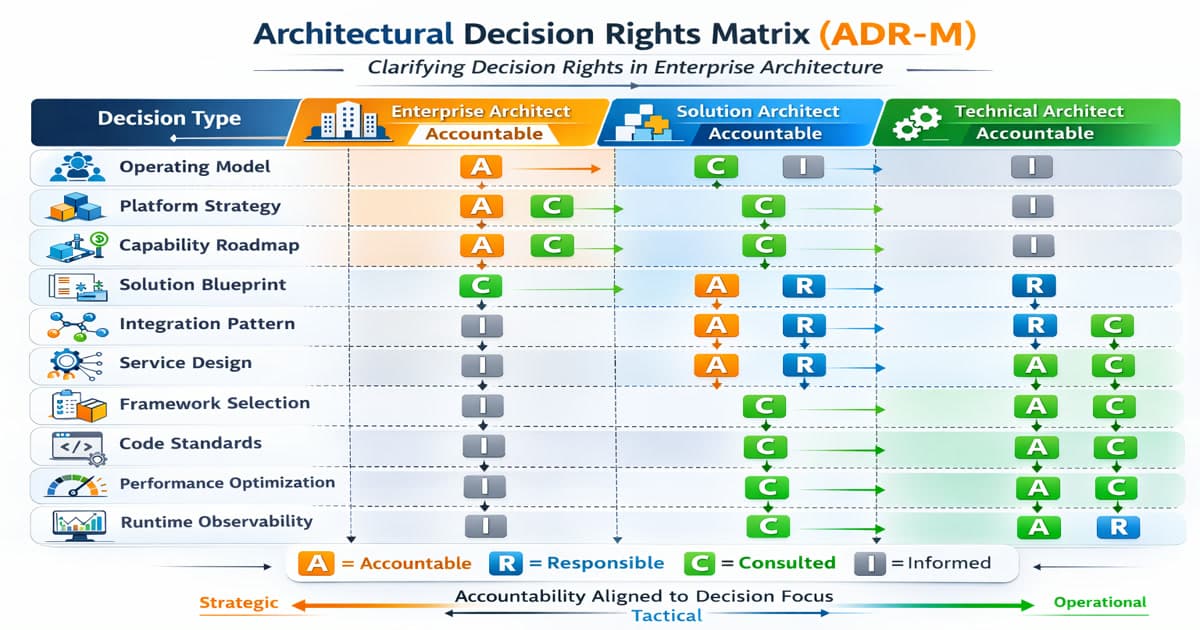
Architectural Decision Rights Matrix: Governing Enterprise, Solution, and Technical Architecture

A governance framework introducing the Architectural Decision Rights Matrix (ADR-M) to clarify accountability between Enterprise, Solution, and Technical Architects in Context-Driven Architecture.

...Architectural Decision Rights Matrix (ADR-M) aligned to altitude and risk Time to implement: 30 days Business impact: Reduced architectural conflict, faster decision cycles, improved structural integrity...

Architecture Across the Application Lifecycle: Which Architect Is Needed When?

A practical guide explaining which type of architect is required at each stage of the application lifecycle to prevent governance friction and structural instability.

...outcome: Clear architectural engagement model across lifecycle stages Time to implement clarity: 30 days Business impact: Reduced friction, faster decision cycles, lower architectural rework The Real Problem...