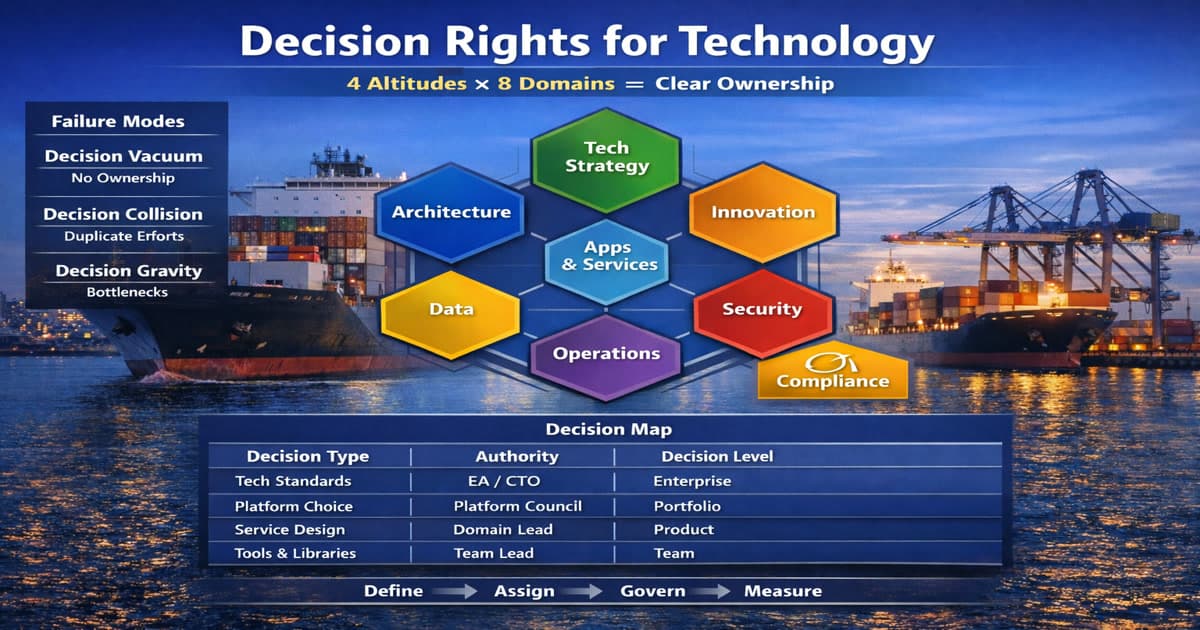
The Canal Lock Does Not Care How Fast the Ship Is Going
A ship enters a canal.
The engine is strong.
The captain is ready.
The crew is aligned.
The destination is clear.
But the ship does not move at engine speed.
Because it is inside a lock.
The lock fills.
The gate opens.
The ship advances.
Then it stops again.
The process repeats.
No amount of urgency changes the physics of the lock.
This is how most organizations behave.
Leadership pushes.
Strategy accelerates.
Teams align.
But execution still moves slowly.
Because the real constraint is not intent.
It is structure.
The Wrong Diagnosis
When decision velocity is slow, organizations usually blame:
- Culture
- Risk aversion
- Leadership hesitation
- Low accountability
These are visible symptoms.
They are not the mechanism.
The actual bottleneck is mechanical.
Your decision architecture was designed for a slower era.
And it is still running at that speed.
Where the Delay Lives
Every strategic decision travels through a system.
Not metaphorically.
Mechanically.
%% caption: Where the delay lives: every handoff between a strategic insight and delivery
flowchart LR
    A["Strategic Insight"] --> B["Alignment Discussion"]
    B --> C["Approval Layer"]
    C --> D["Governance Checkpoint"]
    D --> E["Funding Gate"]
    E --> F["Backlog Prioritization"]
    F --> G["Delivery Execution"]
Each node adds delay.
But not all delay is equal.
Some delay is useful.
Some delay is structural friction.
Some delay is just inherited architecture.
The Mechanical Causes of Delay
- Approval layers create waiting because authority is unclear or duplicated
- Governance checkpoints slow down decisions because they operate in batches
- Funding gates force strategic intent to wait for budget rhythm
- Backlog translation turns one decision into three different interpretations
These delays are not caused by poor leadership.
They are caused by design.
The Asymmetry
Organizations have spent years making strategy faster.
- Quarterly planning
- Monthly pivots
- Agile planning cycles
- Continuous prioritization
But the governance layer often still behaves like this:
- Annual budgets
- Fixed review boards
- Static approval cycles
- Manual sign-off chains
The result is a widening gap.
Strategy speeds up.
Execution does not.
The distance between the two grows.
That is the asymmetry.
%% caption: The asymmetry: strategy speeds up, governance stays flat, and execution lag grows
flowchart LR
    A["Strategy Speed ↑"] --> B["Governance Speed →"]
    B --> C["Execution Lag ↑"]
Decision Velocity Architecture (DVA)
Decision Velocity Architecture (DVA) is a structural model for removing mechanical delay from decision flow.
Its purpose is simple:
If a decision is predictable, it should not need to wait for approval.
DVA does not eliminate governance.
It changes how governance is applied.
It shifts the system from waiting states to pre-authorized states.
The Two Timelines
Current State: Governance-Locked Flow
%% caption: Governance-locked flow: an insight waits through two approval layers, a review and funding before execution
flowchart LR
    A["Insight"] --> B["Approval Layer 1"]
    B --> C["Approval Layer 2"]
    C --> D["Governance Review"]
    D --> E["Funding Approval"]
    E --> F["Backlog Entry"]
    F --> G["Execution"]
This is what slows organizations down.
Every step is a dependency.
Every dependency is a delay.
Every delay becomes a bottleneck when the organization is trying to move faster.
DVA State: Pre-Authorized Flow
%% caption: DVA flow: a pre-authorized decision passes an automated check straight into the backlog
flowchart LR
    A["Insight"] --> B["Pre-Authorized Decision"]
    B --> C["Automated Governance Check"]
    C --> D["Direct Backlog Injection"]
    D --> E["Execution"]
This is what decision velocity looks like.
The decision is made once.
The rules are known in advance.
Governance checks are continuous.
Execution begins without waiting for a meeting.
What DVA Changes
DVA changes the operating logic of the enterprise.
1. From Approval to Pre-Authorization
Instead of asking:
Can we do this?
The organization defines in advance:
Under what conditions is this already allowed?
That one change removes a large amount of waiting.
2. From Batch Review to Continuous Validation
Instead of depending on weekly or monthly review cycles, DVA uses continuous checks.
The decision is validated when it is made.
Not when the board next meets.
3. From Funding Gates to Funding Envelopes
Instead of making teams wait for every individual decision to pass through budget approvals, DVA assigns decision classes a funding envelope.
Within that envelope, execution can proceed.
4. From Translation Layers to Direct Flow
Strategy should not be rewritten three times before execution.
It should enter delivery with minimal distortion.
The fewer translations, the fewer delays.
The Structural Shift
%% caption: Traditional governance makes decisions wait for approval; DVA pre-authorizes them so execution starts at once
flowchart TD
    A["Traditional Governance"] --> B["Decision waits for approval"]
    B --> C["Execution delayed"]

    D["Decision Velocity Architecture"] --> E["Decision pre-authorized"]
    E --> F["Execution immediate"]
Traditional governance asks the organization to wait.
DVA asks the organization to define the boundary once, then move inside it.
That is the shift.
What Breaks Without DVA
When decision velocity is not architected, three things happen.
Strategy Outruns Execution
Leadership produces faster intent than delivery can absorb.
The backlog becomes a translation bottleneck.
Strategy looks smart.
Execution looks slow.
The organization loses confidence in its own operating model.
Shadow Acceleration Emerges
Teams that cannot move inside the system begin moving around it.
They create untracked shortcuts.
They use unapproved tools.
They introduce hidden dependencies.
The business appears faster.
The architecture becomes less governable.
Governance Becomes Theater
Approvals still happen.
Reviews still happen.
Meetings still happen.
But the real decisions were made before the meeting started.
The meeting is no longer a decision point.
It is a documentation ritual.
The Named Concept
Decision Velocity Architecture (DVA) is built on a simple idea:
Speed is not created by urgency. It is created by removing waiting states.
That means the enterprise should classify decisions before they arrive.
Some decisions can be:
- Pre-authorized
- Automatically validated
- Executed directly
Others must remain:
- Manually reviewed
- Escalated
- Held for board-level approval
The system should know the difference before the decision appears.
The DVA Model
%% caption: The DVA model: predictability and reversibility decide whether a decision is pre-authorized, automated or reviewed
flowchart TB
    A["Decision"] --> B{"Is the outcome predictable?"}
    B -- Yes --> C["Pre-authorize"]
    B -- No --> D{"Is the risk reversible?"}
    D -- Yes --> E["Automate with validation"]
    D -- No --> F["Manual approval"]

    C --> G["Direct execution"]
    E --> G
    F --> H["Governance review"]
This is what decision architecture should look like.
Not every decision needs the same path.
Not every decision deserves the same delay.
The Three Delay Nodes to Remove First
If an organization wants faster decision velocity, start here.
1. The Duplicate Approval Node
When the same decision is approved twice by two different groups, the system is already over-governed.
Remove one layer.
Clarify authority.
2. The Batch Governance Node
If a decision is safe enough to be reviewed only once a month, it is usually safe enough to be pre-authorized.
Move low-risk decisions out of batch review.
3. The Funding Translation Node
If strategy must wait for a separate budget interpretation before execution can start, the financial architecture is the bottleneck.
Move to funding envelopes.
What Changes When DVA Exists
When decision velocity is architected properly:
- Strategy can move without waiting for every micro-approval
- Governance becomes continuous instead of episodic
- Execution begins closer to the moment of insight
- Teams stop bypassing process to stay fast
- Leadership spends less time chasing approvals and more time shaping direction
The organization becomes faster without becoming chaotic.
That is the point.
Implementation Guide (30–60 Days)
Phase 1: Map the Current Decision Flow (Weeks 1–2)
Document the real decision path.
Not the formal process chart.
The actual path.
For each major decision class, identify:
- Where does it wait?
- Why does it wait?
- Who is required to move it forward?
Deliverable: Decision flow map with delay nodes identified
Success Metric: At least three structural delays mapped, not just cultural issues
Phase 2: Classify Decision Types (Weeks 3–4)
Group decisions into categories.
For example:
- Pre-authorizable
- Conditionally automatable
- Manual / high-risk
For each category, define:
- Approval required or not
- Validation method
- Escalation boundary
- Funding boundary
Deliverable: Decision classification model
Success Metric: At least half of routine decisions classified as pre-authorizable or conditionally automatable
Phase 3: Redesign the Flow (Weeks 5–8)
Remove unnecessary waiting states.
Convert routine approvals into policy checks.
Convert batch governance into continuous validation.
Convert funding gates into decision envelopes.
Deliverable: New decision flow with fewer waiting states
Success Metric: Measurable reduction in time from insight to execution
Evidence from Practice
A retail company I worked with had a decision-making structure designed for a slower era. Strategic decisions required three layers of approval. By the time approval came, the market had moved. The CEO described it as "making decisions at the speed of governance while the competition moves at the speed of software."
We mapped their decision flow end to end and identified the structural delay nodes — meetings that existed for information-sharing rather than decision-making, approvals that added no value, escalation paths that routed decisions through people who lacked context. We classified decisions into three categories: pre-authorisable, conditionally automatable, and manual. The structural delay was cut by 60%. Strategy, governance, and execution began moving on the same clock.
Action Plan
This Week
Ask three questions:
- Where do decisions wait after they have already been agreed?
- Which approvals could be pre-authorized safely?
- Which governance steps are operating on fixed cadences instead of real-time need?
If the answers are unclear, architecture is the bottleneck.
Next 30 Days
- Map one critical decision path
- Remove one approval layer
- Add one automated validation rule
Start with a single domain where delay is visible and expensive.
3–6 Months
- Build decision classification into architecture governance
- Replace batch review with continuous validation where possible
- Define funding envelopes for routine decision classes
- Align strategy, governance, and execution to the same clock
Final Thought
The ship was ready.
The crew was aligned.
The engine was powerful.
But the lock controlled the speed.
Organizations do not move at the speed of leadership.
They move at the speed of their architecture.
If you want faster decisions, do not push harder.
Redesign the structure that is forcing the wait.
Turn Decision Delay Into Decision Velocity
If your organization keeps making decisions faster than it can execute them…
if governance adds predictable delay to every strategic move…
or if teams are bypassing process just to keep delivery moving —
then the problem is not leadership speed.
It is architectural design.
In a focused 30-minute Decision Velocity Diagnostic, we will:
- Identify the structural delay nodes in your current decision flow
- Classify decisions into pre-authorizable, conditionally automatable, and manual
- Define a Decision Velocity Architecture for your highest-friction domain
- Build a 30-day plan to reduce waiting states without weakening governance
No process theater.
No committee sprawl.
No more strategy waiting in line behind structure.
Just an architecture that moves at the speed of decision.
→ Book a Decision Velocity Diagnostic
or
The engine is rarely the problem. The lock is.