Five Postings, One Week, No Definition
This week, I ran a scan of live job postings across New Zealand and Australia — LinkedIn Jobs and Seek, cross-checked against each other.
New Zealand's transport agency posted for a Principal Data and AI Governance Advisor.
One of Australia's largest retail groups posted for an AI Governance Manager.
A state emergency service posted for an AI Governance and Strategy Manager.
A global audit and consulting firm posted an AI-governance-titled advisory role.
A Big Four firm's New Zealand office posted an Enterprise Architect role with "AI Enabled Transformation" in the title — job description built almost entirely around dividing decisions between people and AI, with human oversight and escalation through governance forums.
None of these are "AI Strategy" roles. None of them are "Enterprise Architect, does some AI stuff" roles.
They are named, budgeted, standalone AI Governance seats.
That is new. A year ago, this work lived as an unnamed fraction of someone else's job description.
The Job Descriptions Ask for the Right Things — In the Wrong Order
Read the postings closely and a pattern shows up immediately.
They ask for "guardrails." They ask for "assurance mechanisms." They ask for someone to "shape policies, controls, and operating models." They ask for someone who can "escalate material issues through the appropriate governance forums."
Every one of those phrases is describing a decision-rights problem.
None of them names the decision-rights answer.
- Which AI decisions, specifically, does this role have the authority to block?
- Which decisions can this person approve unilaterally, and which need sign-off above them?
- When this role and a business unit disagree about whether an AI system should ship, who actually has the final call?
The postings ask a capable person to walk in and answer these questions themselves, on the job, usually during the first real disagreement — which is the most expensive possible time to be discovering the answer.
This is the same failure AIDRA was built to catch in AI agents. It just moved up a level, from the AI system to the human hired to govern it.
Applying AIDRA to the Role Itself
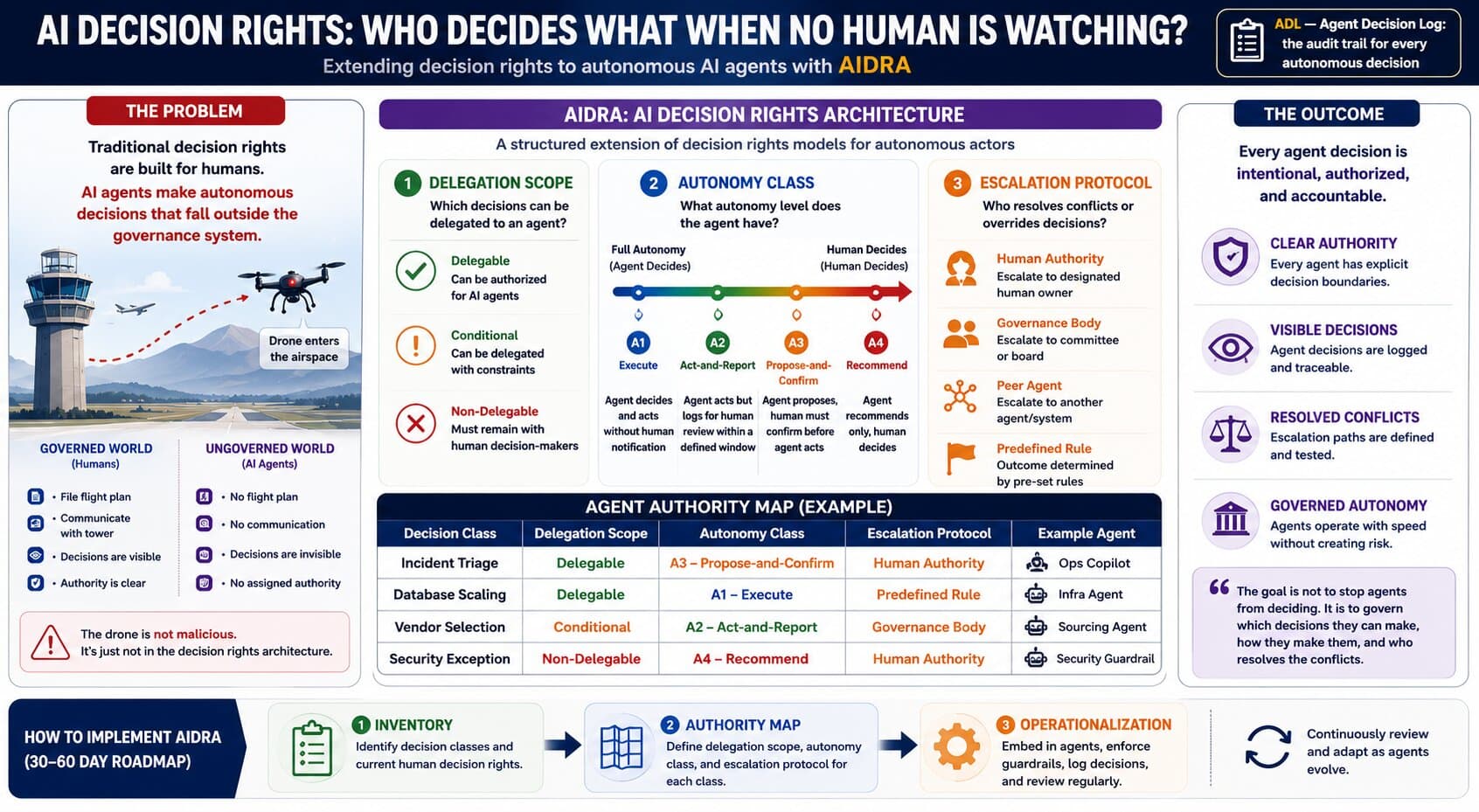
AIDRA (AI Decision Rights Architecture) maps authority for autonomous AI actors across three dimensions: Delegation Scope, Autonomy Class, and Escalation Protocol.
The framework was built to answer which AI decisions can an agent make, at what autonomy level, and who resolves the conflict when a human and an agent disagree.
The same three questions apply — almost unchanged — to the human hired to govern those agents.
Delegation Scope Owner
Before the role exists, someone needs to list every AI decision class the organization expects this hire to touch, and classify each one.
| Delegation Class | What It Means for the AI Governance Role | Example |
|---|---|---|
| Delegable | The role can authorize this decision alone | Approving a low-risk internal copilot use case against an existing policy |
| Conditional | The role can authorize it, but only with a named second sign-off | Approving a customer-facing AI feature, conditional on legal or privacy review |
| Non-Delegable | The role can recommend, but the decision stays with the executive team or board | Whether the organization adopts an agentic AI system with autonomous financial authority |
A job description that never draws this table is asking the hire to guess where the lines are.
Autonomy Class Owner
This is the dimension the postings skip entirely: how much authority does the role itself have, against the executive team that created it?
Is this person able to block a product launch unilaterally (something close to AIDRA's A1 — Execute)? Can they act and report after the fact (A2)? Do they have to propose and get confirmation before any material decision (A3)? Or are they purely advisory, with decisions made elsewhere (A4)?
Every posting I read implied A1-level authority in its language — "shape," "establish," "drive" — while structurally offering A4-level standing: reporting into committees, coordinating governance forums, escalating rather than deciding.
That gap is not a paperwork problem. It is the reason capable AI governance hires burn out or quietly become rubber stamps within a year.
Escalation Protocol Owner
Every posting mentions escalation. Almost none names an escalation target with any specificity.
"Escalate through the appropriate governance forums" answers where the conflict goes. It does not answer who resolves it once it's there — particularly when the forum itself is split, or when the disagreement is with the executive sponsor who created the role in the first place.
AIDRA's own answer for AI-to-AI conflict is instructive here: either a priority rule (one domain's authority prevails by design) or escalation to a named human — never an unnamed committee.
The same discipline belongs in the AI Governance role's own job description. Name the person. Not the forum. The person.
What This Looks Like Applied
Take the NZ Transport Agency posting as an illustration — not a critique, a real and reasonably well-specified role, and a useful example precisely because it is one of the stronger postings in the scan.
The role is asked to "establish clear accountability for data ownership, stewardship and AI oversight" and to "influence major programmes, platforms, digital products and AI-enabled initiatives."
Run that through the three-owner lens:
- Delegation Scope: Which of those "major programmes" can this role greenlight or block directly, and which require sign-off from the programme's own executive sponsor? The posting doesn't say — and it should, before day one.
- Autonomy Class: "Influence" is doing a lot of work in that sentence. Influence is not the same authority level as approve, and a strong candidate will want to know which one they're actually being hired to do.
- Escalation Protocol: If this role and a programme director disagree about whether an AI initiative meets the governance bar, the posting names governance forums generally — not the specific person who breaks the tie.
None of this means the role is poorly conceived. It means the authority map that should sit underneath the job description hasn't been built yet — and the person hired into it will build it themselves, informally, under pressure, during their first real conflict.
That is exactly the "delegation by design vs. delegation by exhaustion" problem AIDRA names for AI agents. It applies to the human governing them with almost no translation required.
Why This Matters Now, Not Later
Hiring cycles for these roles are open now, across both countries, at real salaries — not hypothetical future demand.
An organization that writes the job description after completing the authority map gets a hire who can operate from day one, defend their decisions when challenged, and escalate cleanly when they hit a boundary.
An organization that writes the job description before completing the map gets a capable person absorbing an undefined mandate — and a governance function that looks real on the org chart while remaining, functionally, exactly as ungoverned as it was before the hire.
The seat existing is not the same as the authority being defined.
Action Plan
This Week
If you are creating — or have recently filled — an AI Governance role, ask three questions:
- Can you list, today, the specific AI decisions this role can approve without further sign-off?
- Do you know this role's own autonomy level against the executive team, or only its reporting line?
- If this role disagreed with your most senior AI sponsor tomorrow, is there a named person who resolves it — or only a forum?
If any answer is unclear, the role exists before its authority does.
Next 30 Days
Build the Delegation Scope, Autonomy Class, and Escalation Protocol for the role — using the same AIDRA structure you would use for an AI agent, applied to the human governing them.
Write or rewrite the job description from that map, not from a list of responsibilities.
60–90 Days
Extend the same three-owner model to every AI-governance-adjacent role being created this hiring cycle — not just the flagship "AI Governance" title, but the architecture, risk, and platform roles that will share authority with it.
Review the map at the same cadence as your architecture governance cycle, not as a one-time hiring exercise.
Final Thought
Application security did not become its own function because a committee scheduled the transition. It became untenable to leave undefined, and the org chart eventually caught up.
AI governance is at the same inflection point right now — except the org chart is arriving first, and the definition of the work is still catching up to it.
Five organizations, two countries, one week. The seats are real. The authority underneath them, mostly, is not yet.
AIDRA was built to make sure an AI agent never operates past a boundary nobody defined.
The same discipline, pointed at the role created to enforce it, closes the gap before the first hire discovers it the hard way.
Define the AI Governance Role Before You Fill It
If you're writing — or have just filled — an AI Governance, AI Strategy, or AI-enabled Enterprise Architect role and the job description reads more like a list of responsibilities than an authority map…
if "escalate through governance forums" doesn't yet resolve to a named person…
or if you're not sure whether the role has A1-level authority or A4-level standing…
the seat may exist before its decision rights do.
In a focused 30-minute AI Decision Rights Diagnostic, we will:
- Map the AI decision classes the role is meant to own, using Delegation Scope, Autonomy Class, and Escalation Protocol
- Pressure-test the job description against the authority it actually implies
- Name the specific escalation owner for the conflicts the role can't resolve alone
- Define a 30-day plan to complete the authority map before — or shortly after — the hire starts
No governance frameworks that exist only in the job description.
No authority that gets discovered during the first real disagreement.
Just a role with its boundaries defined before someone has to find them the hard way.
→ Book an AI Decision Rights Diagnostic
or
The seat is already on the org chart.
The question is whether its authority is too.