Search

Find insights, training programs, and workshops

The Architecture Evolution Model: How Architecture Changes from Startup to Enterprise

A practical framework explaining how software architecture evolves from startup experimentation to enterprise-scale governance, and what architectural practices are needed at each stage.

Executive Summary Who this is for: CTOs, founders, Enterprise Architects, technology leaders scaling systems Problem it solves: Applying enterprise architecture too early or startup...

The Capability Map That Cannot Answer a Question Is Not a Capability Map

Why traditional capability maps fail to support governance decisions and how Queryable Capability Architecture turns static maps into interrogable decision systems.

...capability model Business impact: Better governance decisions, clearer ownership visibility, reduced technology duplication, and improved investment alignment The Capability Map Illusion Almost every large...

Architecture Governance
Intermediate to Advanced (SA, EA, TS)5-6 hoursGovernance model canvas + architecture principles register + escalation path template

How to design, implement, and measure architecture governance — the mechanisms that ensure decisions are made consistently, applied correctly, and aligned with strategy.

...decisions are made consistently, applied correctly, and aligned with the organisation's principles and strategy. It's not bureaucracy — it's the system that makes architecture matter. Governance without teeth...

1 DayIntensive
PracticalSA · EA · TS
Why Architecture Exists
All levels — SA, EA, TS3-4 hoursArchitecture purpose framework — complexity · alignment · risk · change · shared understanding

Why architecture exists — managing complexity, aligning technology with business, reducing risk, enabling change, and creating shared understanding across teams.

...Start here — Why does architecture exist? The problem architecture solves Reducing complexity Aligning technology with business Managing risk Enabling change Architecture as communication Putting it all together Cheat...

Half-dayIntensive
PurposeWhy it matters
AI Decision Rights: Who Decides What When No Human Is Watching?

Decision rights models assume human decision-makers. AI agents breach that assumption silently. Here is how to extend decision rights to cover autonomous actors before the first ungoverned decision becomes a production incident.

...the authority map. It does not replace your existing decision rights framework — whether that is a Technology Decision Domain Architecture (TDDA) map, a RACI model, or an architecture governance charter....

Architectural Decision Rights Matrix: Governing Enterprise, Solution, and Technical Architecture

A governance framework introducing the Architectural Decision Rights Matrix (ADR-M) to clarify accountability between Enterprise, Solution, and Technical Architects in Context-Driven Architecture.

...decision altitude clarity. Enterprise Architects debate frameworks. Solution Architects redefine platform strategy. Technical Architects override structural principles. Roles exist. Authority boundaries do not....

Architecture Across the Application Lifecycle: Which Architect Is Needed When?

A practical guide explaining which type of architect is required at each stage of the application lifecycle to prevent governance friction and structural instability.

...Lifecycle Stages Every application — whether startup or enterprise — passes through five functional stages: Strategy & Intent Discovery & Feasibility Solution Design Build & Delivery Operate, Scale & Modernize...

Batch vs Real-Time Is the Wrong Debate.

Organisations debate batch versus real-time as if it is a technical preference. It is not. It is a structural mismatch between data freshness and decision cadence — and the mismatch is where the cost lives.

...real questions. They are being asked at the wrong altitude. The debate assumes the choice is about technology. It is not. It is about the decision being served. Nobody asks the structural question first:...

Decision Velocity Is Not a Leadership Problem. It Is an Architecture Problem.

Decision velocity is not constrained by leadership intent but by architectural design. Governance systems built for slower eras create mechanical delay between insight and execution.

Executive Summary Who this is for: CTOs, CIOs, Enterprise Architects, Strategy Leaders, Operating Model Owners Problem it solves: Strategic decisions move faster than execution...

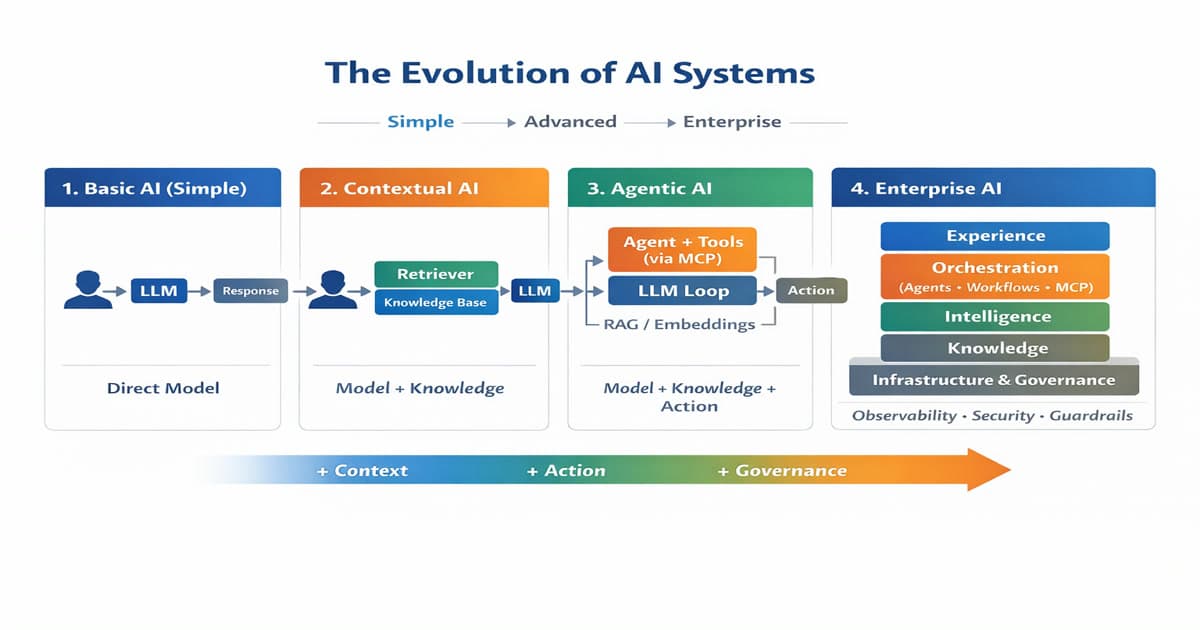
MCP Is Not an AI Protocol. It Is a Governance Layer.

MCP is classified as an AI integration protocol. It is actually a governance primitive — the stable interface layer that architecture fitness functions have been missing for years.

...evolves. Implementation Guide (30–60 Days) Introducing IDG requires a governance contract more than new technology. MCP server infrastructure is already available in most delivery environments. The missing...