Search

Find insights, training programs, and workshops

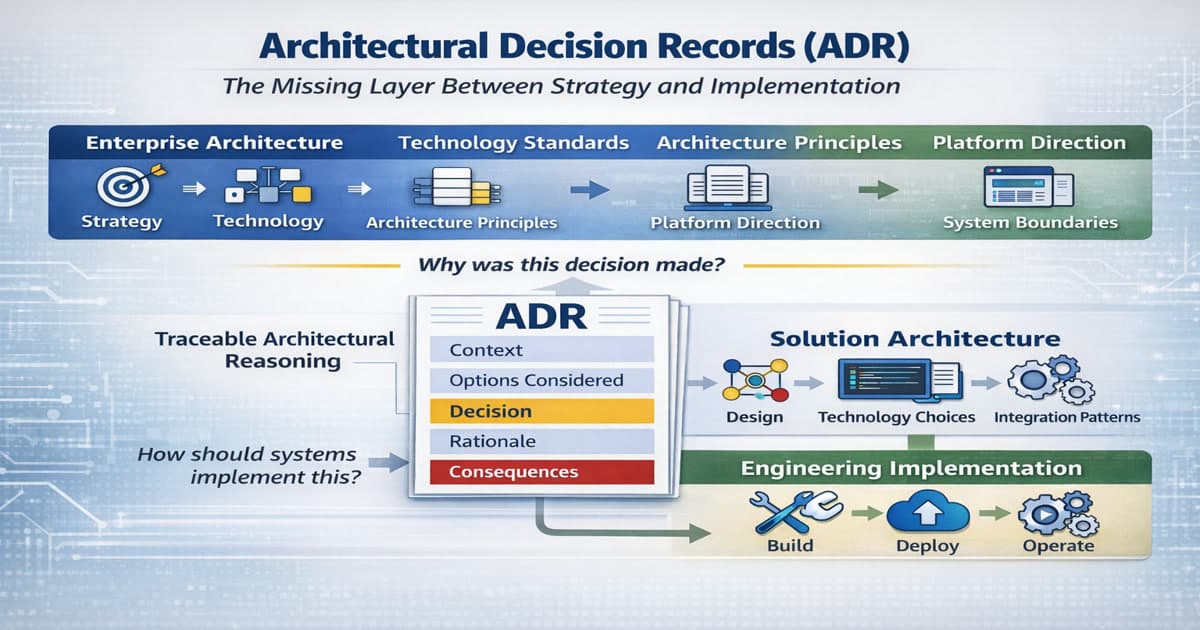
Architectural Decision Records (ADR): The Missing Layer Between Strategy and Implementation

A practical guide explaining why Architectural Decision Records (ADR) are the missing link between enterprise architecture strategy and engineering implementation.

...Architects, Solution Architects, Engineering Leaders Problem it solves: Architecture strategy exists but decision logic is undocumented and lost Key outcome: A structured way to capture architectural decisions...

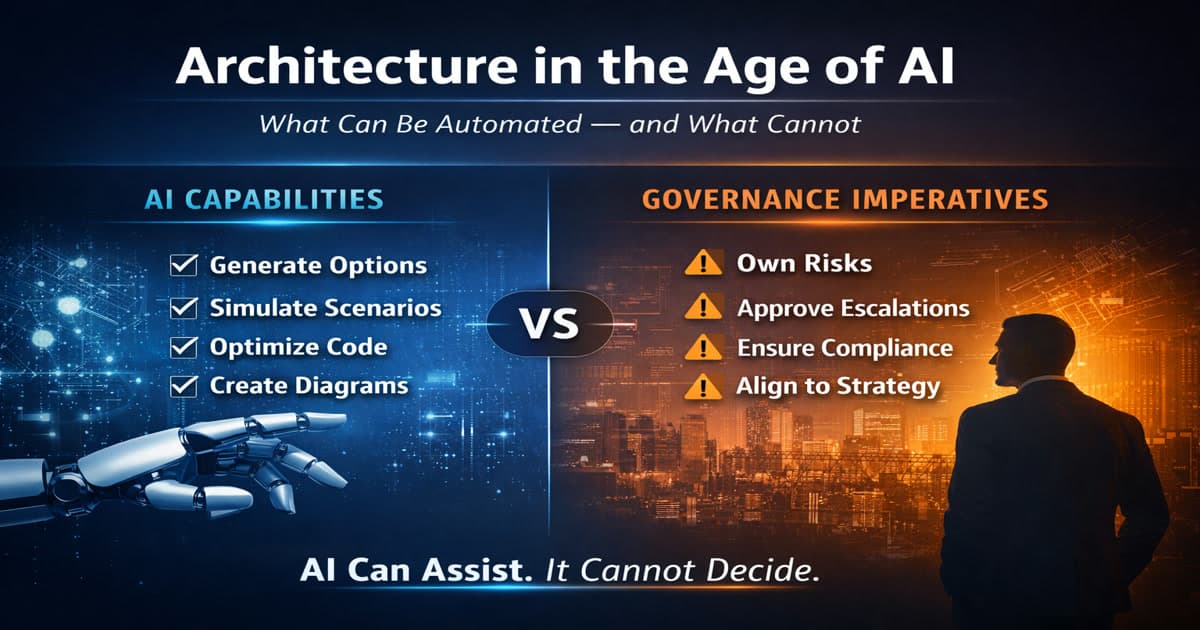
Architecture in the Age of AI: What Can Be Automated — and What Cannot

A governance-driven perspective explaining why software architecture cannot be automated because decision accountability and consequence ownership cannot be delegated to AI.

...cannot own architectural accountability Core outcome: Clear distinction between mechanical design and decision governance Time to implement: 30–60 days Business impact: Protects structural stability in an...

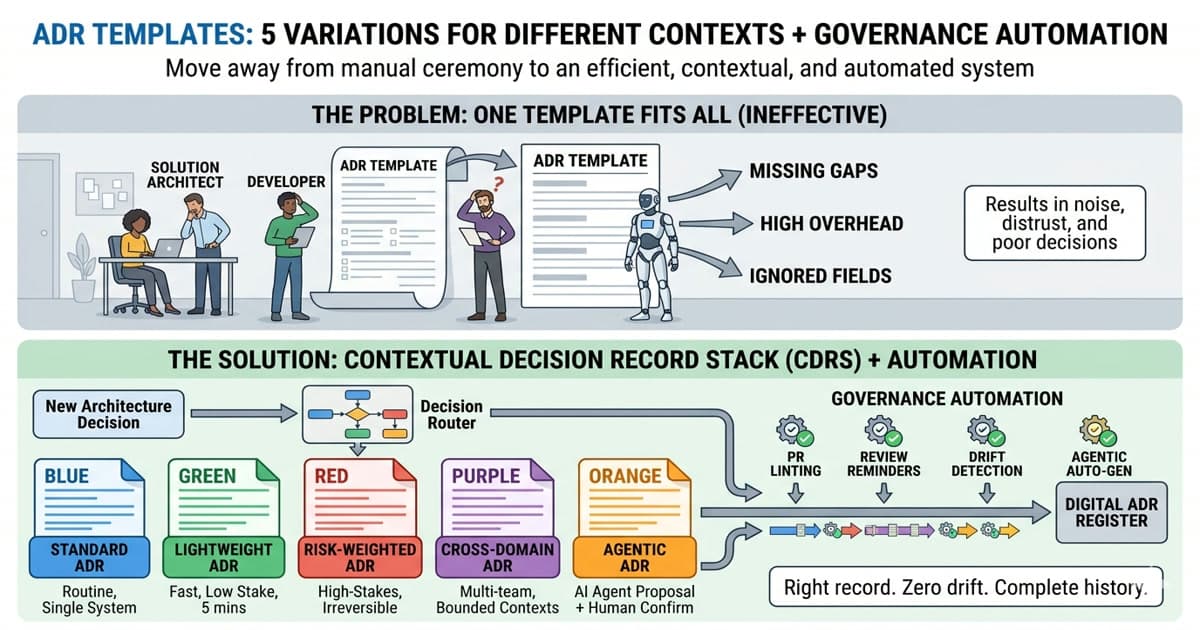
ADR Templates: 5 Variations for Different Contexts + Governance Automation

One ADR template does not fit every architectural context. Five purpose-built variations — for standard decisions, agentic AI, cross-domain impact, fast delivery, and high-risk reversals — plus governance automation to make the system run without manual follow-up.

...Architecture Leads, Engineering Managers Problem it solves: A single ADR template applied to every decision produces incomplete records, ignored fields, and governance that nobody trusts Key outcome:...

Stakeholder Management & Politics
Intermediate to Advanced (SA, EA, TS)5-6 hoursStakeholder map template + conflict resolution framework + executive alignment guide

How to navigate organisational dynamics, manage conflicting priorities, resolve decision deadlocks, and build executive alignment — because the best architecture recommendation fails without stakeholder alignment.

...an architecture concern Stakeholder mapping Managing conflicting priorities Difficult stakeholders Decision deadlocks Executive alignment Organisational resistance Putting it all together Cheat sheet...

1 DayIntensive
StrategicSA · EA · TS
Technology Leadership vs Technology Governance: Why Confusing the Two Creates Structural Instability

A structured executive guide explaining the difference between Technology Leadership and Technology Governance, and why confusing the two creates instability in enterprise execution.

...mechanisms Time to implement clarity: 30–60 days Business impact: Reduced political friction, faster decision cycles, stronger execution stability The Quiet Tension Inside Technology Organizations Many...

Analyzing Business Strategies: From Strategic Intent to Execution Discipline

A structured executive guide to analyzing business strategies using a four-layer framework that connects intent, positioning, capability, and execution discipline.

...The Control Layer Even a well-designed strategy fails without execution governance. You must define: Decision rights Capital allocation rules Performance metrics Incentive alignment Risk management thresholds...

Architecture vs Design: Why Most Organizations Confuse Them

A clear explanation of the difference between architecture and design, why organizations confuse them, and how this confusion creates structural instability in technology systems.

...and design in software and technology organizations Key outcome: Clear structural separation between decision-making architecture and implementation design Time to implement clarity: 30 days Business impact:...

Requirement Clarity: How Structured Persona Definition Reduces Rework and Misalignment

A structured framework for defining personas that eliminates scope creep, reduces rework, and aligns engineering delivery with actual user needs — before development begins.

...requirements leading to scope creep and rework Key outcome: Clear ownership, measurable alignment, reduced decision friction Time to implement: 30–60 days for structured rollout Business impact: Reduced rework,...

Enterprise, Solution, and Technical Architects: Who Does What in a Context-Driven Architecture?

A structured executive guide explaining the difference between Enterprise, Solution, and Technical Architects using Context-Driven Architecture to clarify responsibilities and reduce structural misalignment.

...Guide (30 Days) Phase 1: Role Clarification (Weeks 1–2) Document architectural role definitions Define decision boundaries Align reporting lines Clarify escalation pathways Success Metric: No architectural...

AI Operating Model & Team Design
Intermediate4-5 hoursAI operating model blueprint + team role map + governance forum design

AI success is not just about tools. It depends on how teams are organised, who owns what, how standards are set, and how delivery, governance, and platform capabilities work together.

...organisation design matters The major operating model patterns Platform, product, and governance roles Decision rights and ownership Capability pathways and centres of gravity How capability scales across...

1 DayStrategy
Operating ModelDesign