Search

Find insights, training programs, and workshops

Data and AI
Intermediate4-6 hoursData readiness assessment + governance framework + pipeline blueprint

The data foundations that make AI work. Data quality, governance, architecture, pipelines, and the GenAI shift from training to retrieval. Most AI failures are data failures — learn the patterns and prevent them.

Quick Navigation The data problem AI exposes Data quality — the six dimensions Data governance — who owns and protects it Data...

1.5 DaysIntensive
Data ReadinessAssessment
Data & AI Direction
Intermediate to Advanced (SA, EA, TS)5-6 hoursData and AI direction framework + AI readiness assessment + governance overlay

How data strategy and AI direction connect to architecture — covering data quality, governance, data architecture for AI, AI enablement, responsible AI, data products, data mesh, and building a data and AI roadmap.

Quick Navigation Start here — Why data strategy is an architecture concern Data quality and governance Data architecture for AI AI enablement Responsible...

1.5 DaysIntensive
CurrentSA · EA · TS
Quality Attributes / -ilities
SA, EA — Intermediate5-6 hoursQuality attribute reference card + -ility prioritisation matrix

The non-functional characteristics that determine whether a system is truly fit for purpose — scalability, reliability, availability, performance, security, maintainability, and more.

Quick Navigation Start here — What quality attributes are The core -ilities How -ilities conflict Tactics for each How to prioritise How...

1 DayIntensive
SA · EARoles
AI Risk Patterns & Failure Modes
Beginner to Intermediate4-5 hoursAI risk pattern map + mitigation checklist + failure review template

Most AI failures are predictable. Learn the recurring patterns behind hallucinations, automation bias, data leakage, brittle workflows, hidden costs, and false confidence before they become expensive.

...trust fluent output too quickly, teams automate tasks without designing proper review, weak source data gets dressed up in impressive interfaces, and governance arrives after the workflow is already live....

1 DayPractical
Risk AwarenessOperational
AI Evaluation, Testing & Validation
Intermediate to Advanced4-6 hoursEvaluation framework + test matrix + validation workflow

If you cannot evaluate an AI system, you cannot trust it. Learn how to test prompts, retrieval, agents, workflows, and production behaviour before confidence turns into risk.

...AI outputs are often plausible, variable, and context-sensitive. That makes casual inspection a weak quality method. If you want reliable use, you need a repeatable way to test performance, compare versions,...

1 DayHands-on
ValidationCore Discipline
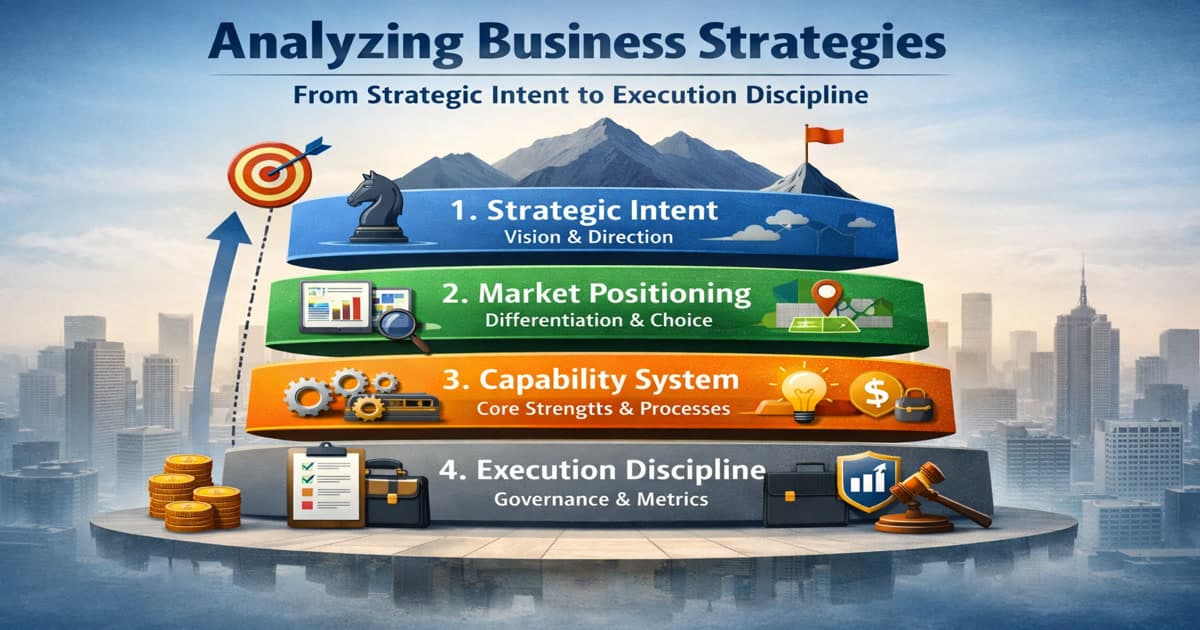
Analyzing Business Strategies: From Strategic Intent to Execution Discipline

A structured executive guide to analyzing business strategies using a four-layer framework that connects intent, positioning, capability, and execution discipline.

...leadership Focused niche vs mass market Platform ecosystem vs product excellence If a company claims: High quality Lowest price Fastest delivery Most innovative Simultaneously… It likely has no positioning discipline....

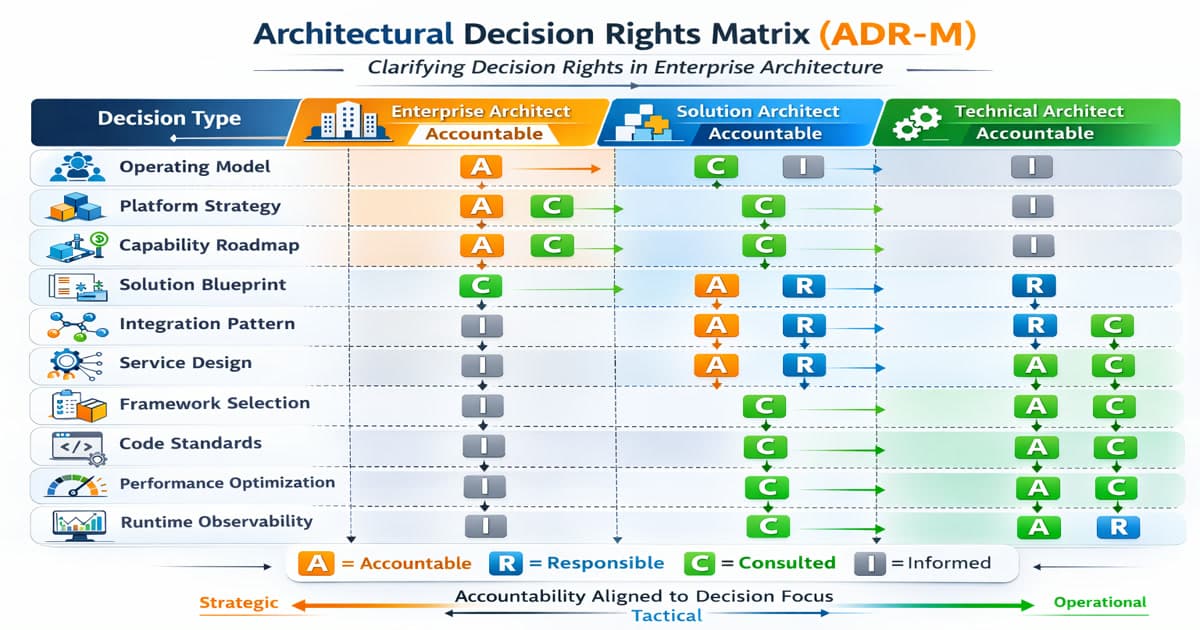
Architectural Decision Rights Matrix: Governing Enterprise, Solution, and Technical Architecture

A governance framework introducing the Architectural Decision Rights Matrix (ADR-M) to clarify accountability between Enterprise, Solution, and Technical Architects in Context-Driven Architecture.

...Architect Technical Architect Solution Blueprint C A R Integration Pattern C A R Service Boundaries I A R Data Flow Design C A R Resilience Mechanism C A R Structural instability occurs when this layer is bypassed....

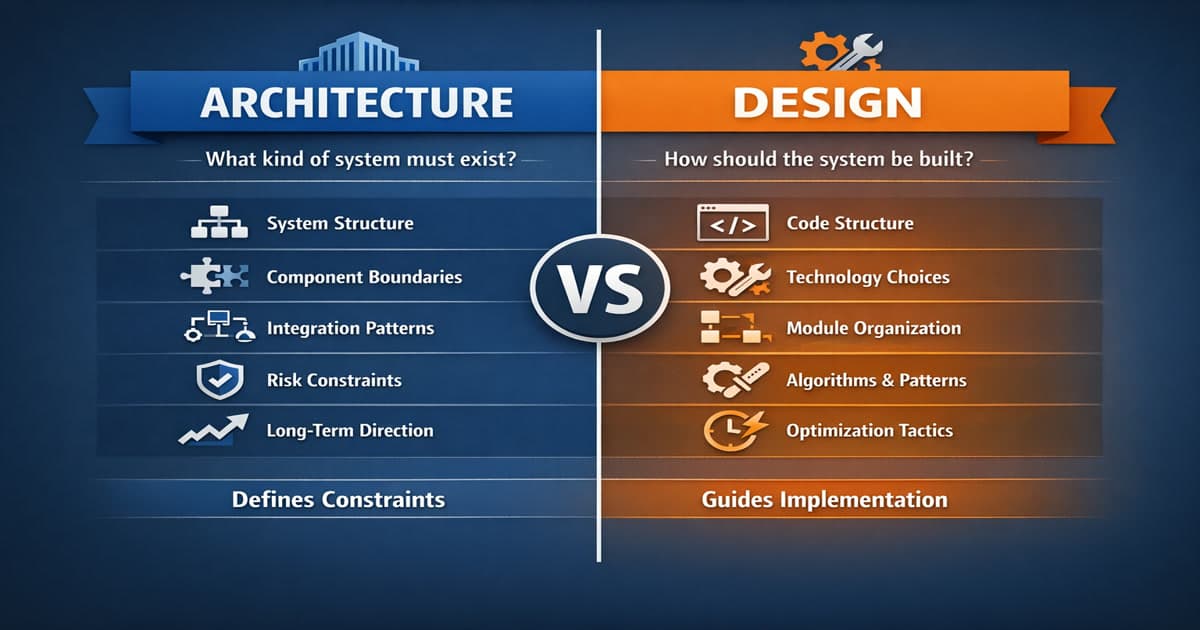
Architecture vs Design: Why Most Organizations Confuse Them

A clear explanation of the difference between architecture and design, why organizations confuse them, and how this confusion creates structural instability in technology systems.

...capabilities must exist? How are major components separated? What integration patterns are allowed? Where are data ownership boundaries? What technology constraints exist? What risks must be controlled? Architecture...

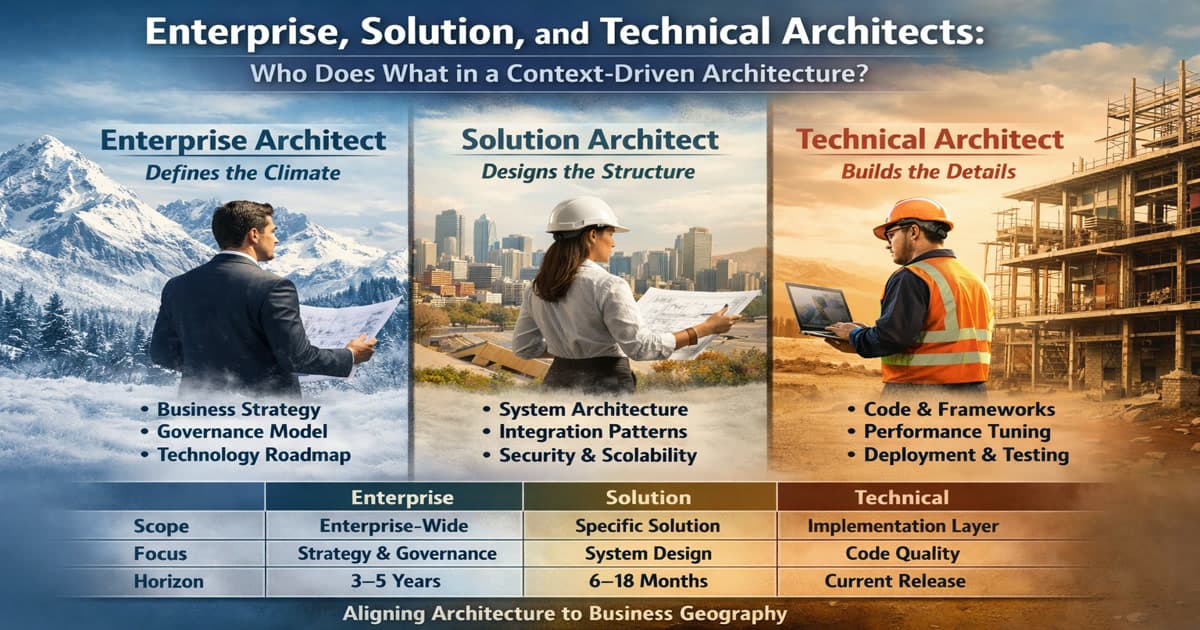
Enterprise, Solution, and Technical Architects: Who Does What in a Context-Driven Architecture?

A structured executive guide explaining the difference between Enterprise, Solution, and Technical Architects using Context-Driven Architecture to clarify responsibilities and reduce structural misalignment.

...They design specific systems and initiatives. They define: Service boundaries Integration patterns Data flows Security patterns Resilience mechanisms Technology selection within policy They answer: “How...

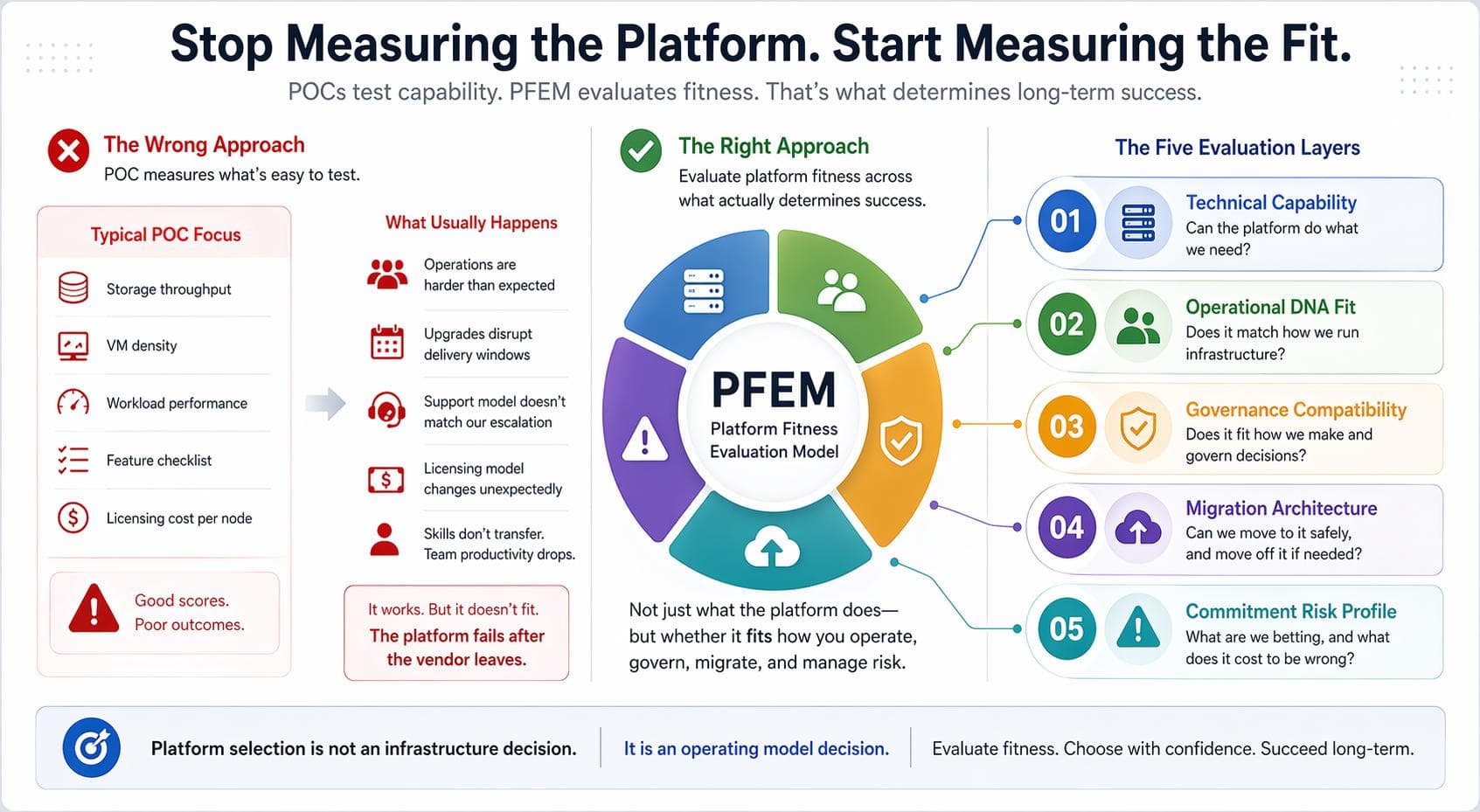
Your HCI Proof of Concept Measures the Wrong Thing.

Most organizations evaluate private cloud and HCI platforms by running a technical POC. The POC passes. The platform fails. The reason is structural — and fixable. The Platform Fitness Evaluation Model (PFEM) tells you what to measure instead.

...governance. Compliance posture: Does the platform's native security model align with your compliance requirements — data residency, encryption at rest, audit logging, access control? Multi-team governance: If multiple...