Skip to content

Search

Find insights, training programs, and workshops

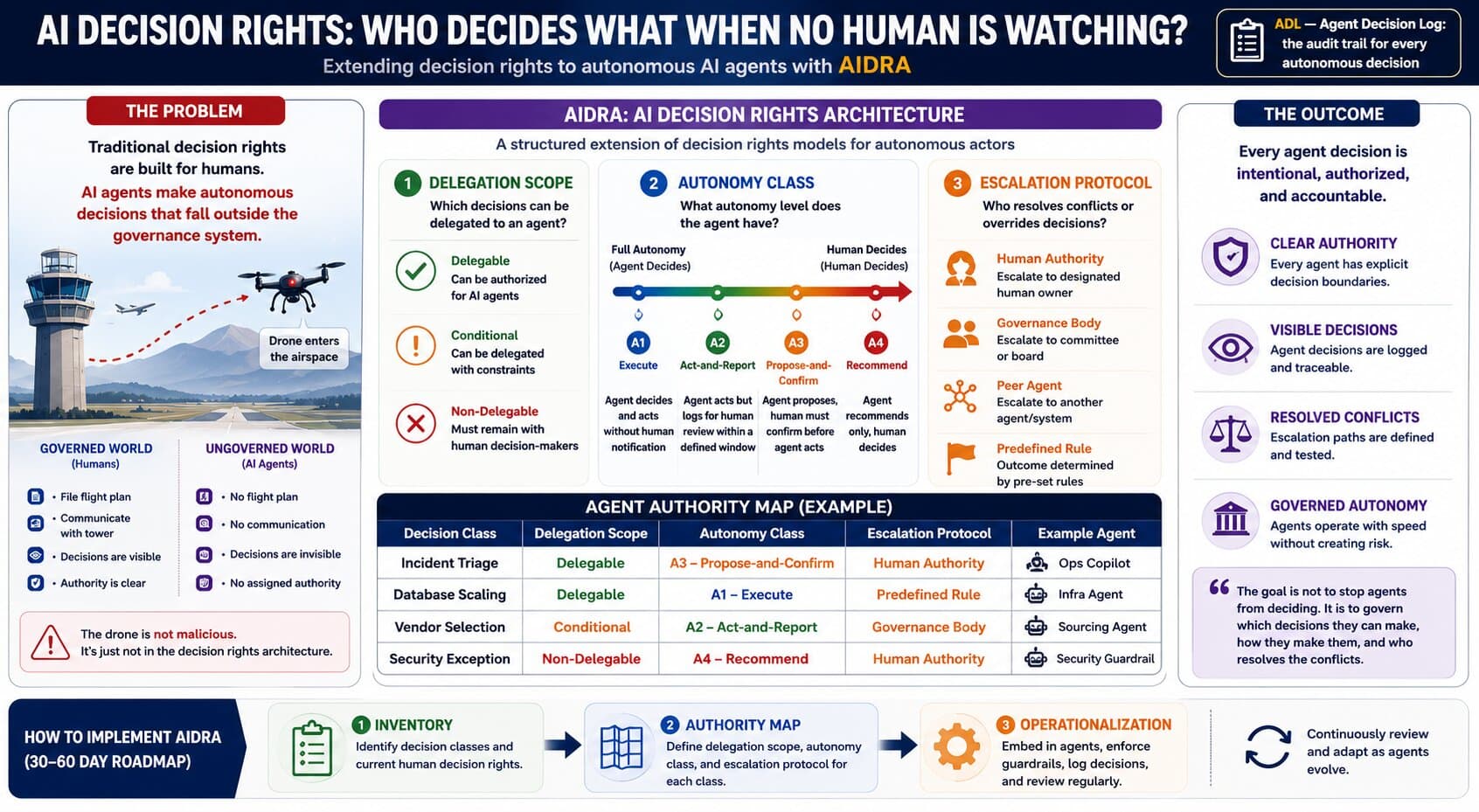
AI Decision Rights: Who Decides What When No Human Is Watching?

Decision rights models assume human decision-makers. AI agents breach that assumption silently. Here is how to extend decision rights to cover autonomous actors before the first ungoverned decision becomes a production incident.

Executive Summary Who this is for: CTOs, Enterprise Architects, AI Governance Leads, Architecture Board Members, Heads of Engineering Problem it solves: Decision rights...

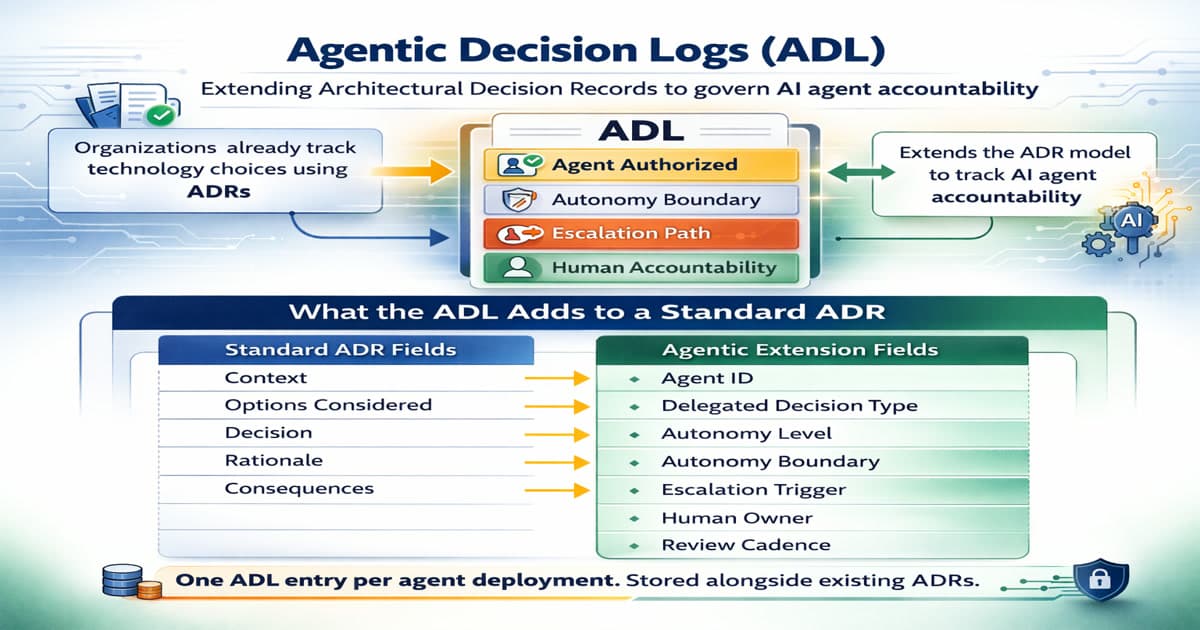
Nobody Uses ADRs as an Agentic Decision Log. They Should.

Why Architectural Decision Records are the only structure most organizations already have that can govern AI agent accountability — and how to extend them into an Agentic Decision Log before the EU AI Act deadline.

Executive Summary Who this is for: Enterprise Architects, CTOs, Solution Architects, Architecture Governance Teams Problem it solves: Organizations deploying AI agents have no structural record of who...

Risk, Compliance & Control Points
Intermediate to Advanced (SA, EA, TS)5-6 hoursRisk and control register template + compliance mapping guide + architecture risk heat map

How architecture manages technical risk and meets regulatory obligations — covering architectural risk analysis, compliance by design, privacy by design, security controls as decisions, operational risk, control points, and demonstrating compliance through architecture.

...technical risk and meet regulatory obligations. The structure of a system — its boundaries, integrations, data flows, and access controls — determines its exposure. I've seen teams wait until the security review...

1 DayIntensive
CriticalSA · EA · TS
AI Risk Patterns & Failure Modes
Beginner to Intermediate4-5 hoursAI risk pattern map + mitigation checklist + failure review template

Most AI failures are predictable. Learn the recurring patterns behind hallucinations, automation bias, data leakage, brittle workflows, hidden costs, and false confidence before they become expensive.

...controls before those patterns cause operational harm. That kind of literacy changes the tone of AI governance. It replaces panic with pattern recognition. It also creates a healthier culture around AI...

1 DayPractical
Risk AwarenessOperational
Standards & Reference Architectures
Intermediate (SA, EA)4-5 hoursReference architecture library starter + standards register + architecture principles catalogue

How to create, govern, and operationalise architecture standards and reference architectures — the agreed patterns and structures that create consistency, reduce duplication, and accelerate delivery at scale.

...re-solving solved problems. What standards are: Pre-decided choices — "We use PostgreSQL for relational data" so teams don't re-debate the database every project. Guardrails — "All APIs must be versioned"...

1 dayIntensive
PracticalStandards exercise
AI Operating Model & Team Design
Intermediate4-5 hoursAI operating model blueprint + team role map + governance forum design

AI success is not just about tools. It depends on how teams are organised, who owns what, how standards are set, and how delivery, governance, and platform capabilities work together.

...failures Why organisation design matters The major operating model patterns Platform, product, and governance roles Decision rights and ownership Capability pathways and centres of gravity How capability...

1 DayStrategy
Operating ModelDesign
Decision Rights & Delegation
Engineering Managers, Tech Leads, Directors, CTO, VP Engineering3-4 hoursDecision rights map by altitude and domain, with every gap, overlap and delay node named

Decisions made at the wrong altitude are the commonest source of both bottleneck and drift — which makes delegation a design problem, not a trust problem.

...surfaces weeks later, by which point one decision has been implemented — and unwinding it is no longer a governance conversation, it is a delivery crisis. Decision Gravity. All decisions pull upward, regardless...

1 DayIntensive
AltitudeWho decides what
Fitness Functions Instead of Review Boards
Enterprise Architects, CTOs, Review Board Members, Engineering Leaders3-4 hoursA three-tier fitness function plan — your first three invariants automated, and the board agenda they retire

Batch review cannot govern continuous change. How to encode architectural invariants as automated checks — and what still belongs to the board.

...governs The batch problem What makes a fitness function a fitness function Three tiers of automated governance What happens when a check fails What the board still does better Retiring the agenda, one...

1 DayIntensive
ContinuousNot batched
Delivery Metrics That Mean Something
Engineering Managers, Tech Leads, VP Engineering, CTOs3-4 hoursA delivery scorecard — four DORA signals plus a five-dimension maturity baseline with one named bottleneck

How to replace delivery dashboards that measure activity with signals that tell you which dimension is actually holding delivery back — and what to fix first.

...fly. Most organisations do not treat delivery this way. They say: our architecture is maturing, our governance is improving, we are becoming more agile. Those are feelings, not measurements. You cannot...

1 DayIntensive
EvidenceNot feeling
AI Operating Model Workshop
CTO, CIO, VP Engineering, Enterprise Architects, AI LeadersAI ownership model, governance framework, capability map, 90-day activation plan

Stop running AI experiments in isolation. Build the ownership structure, governance model, and decision rights that turn scattered AI pilots into an organisation-wide capability.

...trust. Keep it in mind. Purpose The goal of this workshop is concrete: design the ownership structure and governance model that lets your organisation move from isolated AI pilots to a coordinated, scalable...

1 DayIntensive
Clear OwnershipAI at Scale