Search

Find insights, training programs, and workshops

AI Use Case Discovery & Prioritization
Beginner to Intermediate4-5 hoursAI use case portfolio + prioritisation matrix + pilot shortlist

The hardest AI question is often not how to build, but what to build first. Learn how to find real use cases, assess fit, sequence experiments, and avoid expensive distractions.

Quick Navigation Before we start — why good AI ideas are rare Why most idea lists fail What makes a strong AI use case The task-fit test The prioritisation...

1 DayWorkshop
Portfolio DesignPractical
What is Generative AI?
Beginner3-4 hoursClear mental model of Generative AI + reference materials

Generative AI — what it actually is, how it works, what it's good at, and where it goes wrong. No hype. No math. Just clarity.

Quick Navigation Start here — What even is AI? What makes Generative AI different? How does it actually work? How did it learn all this? Why does...

Half DayIntensive
Beginner FriendlyNo math required
AI Operating Model Workshop
CTO, CIO, VP Engineering, Enterprise Architects, AI LeadersAI ownership model, governance framework, capability map, 90-day activation plan

Stop running AI experiments in isolation. Build the ownership structure, governance model, and decision rights that turn scattered AI pilots into an organisation-wide capability.

Before we start — the one thing to hold onto Most organisations think they have an AI adoption problem. They don't. They have an ownership problem. I've sat with leadership teams who had...

1 DayIntensive
Clear OwnershipAI at Scale
Human Skills in an AI World
All levels4-5 hoursPersonal skills assessment + development plan + human-AI collaboration playbook

The skills that become more valuable, not less, as AI handles routine work. Critical thinking, creativity, emotional intelligence, ethical judgment, adaptability, and the art of working with AI as a collaborator.

Quick Navigation The AI paradox Critical thinking — evaluating what AI produces Creativity — framing problems AI can't see Emotional...

1 DayIntensive
5 SkillsFramework
MCP Is Not an AI Protocol. It Is a Governance Layer.

MCP is classified as an AI integration protocol. It is actually a governance primitive — the stable interface layer that architecture fitness functions have been missing for years.

...voltage, continuity, and load capacity — through a stable interface that abstracts every internal detail. The electrician can rewire the entire building. The test point still returns the right answer. The...

Future Operating Model
Advanced (EA, TS)5-6 hoursFuture operating model scenarios + AI-native organisation design principles + transition pathway + Communication Structure Heatmap

How organisations will need to restructure their technology capabilities, teams, and governance as AI, automation, and platform thinking reshape what it means to run a technology function.

...here — Why the future operating model must be designed How technology organisations are changing The AI-augmented technology function Platform-based operating models The evolving role of architecture Skills...

1 DayIntensive
StrategicEA · TS
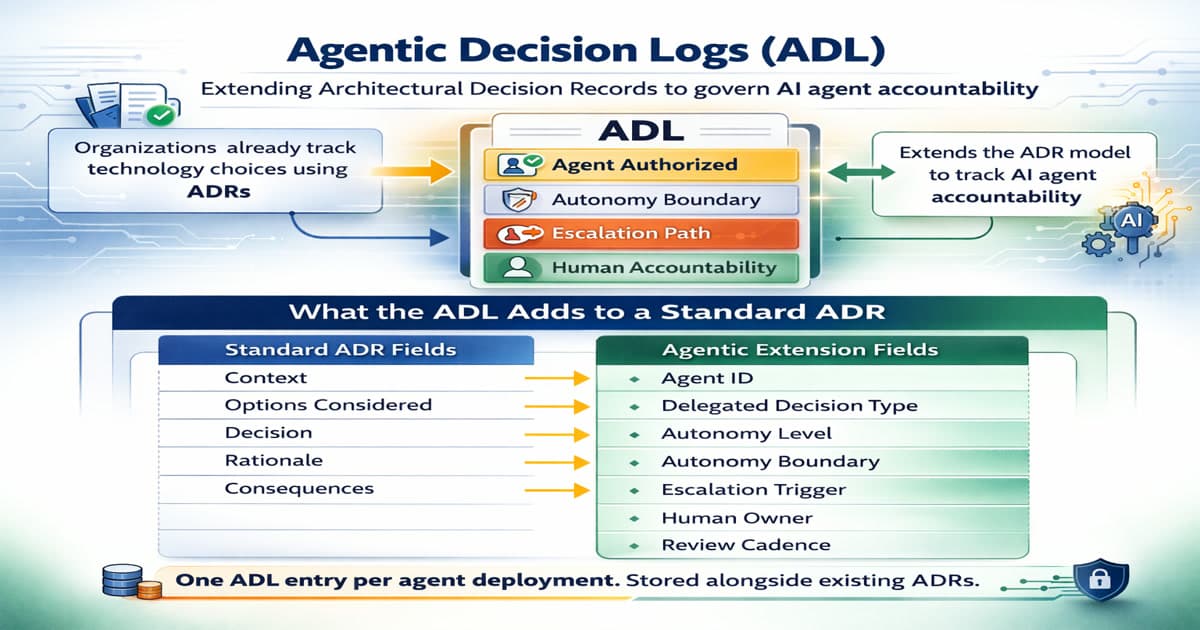
Nobody Uses ADRs as an Agentic Decision Log. They Should.

Why Architectural Decision Records are the only structure most organizations already have that can govern AI agent accountability — and how to extend them into an Agentic Decision Log before the EU AI Act deadline.

...CTOs, Solution Architects, Architecture Governance Teams Problem it solves: Organizations deploying AI agents have no structural record of who authorized the agent to act, what decisions it can make autonomously,...

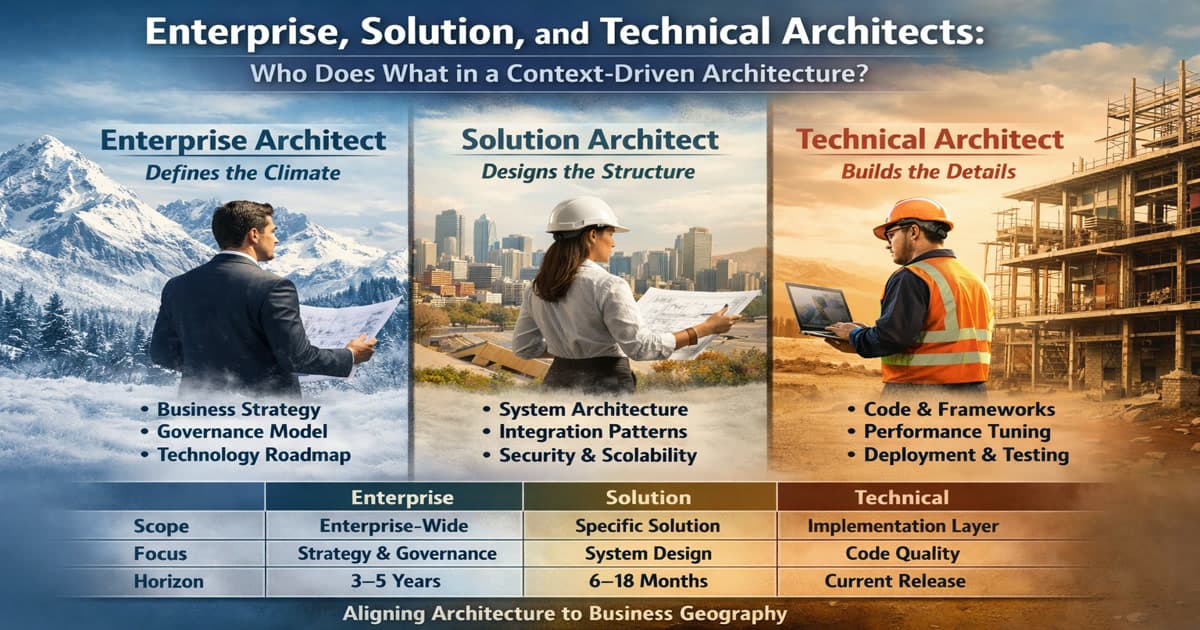
Enterprise, Solution, and Technical Architects: Who Does What in a Context-Driven Architecture?

A structured executive guide explaining the difference between Enterprise, Solution, and Technical Architects using Context-Driven Architecture to clarify responsibilities and reduce structural misalignment.

...Context-Driven Architecture, we established that software must align with business geography. But this raises a critical question: Who decides the climate? Who designs the building? Who selects the materials?...

Technology Leadership vs Technology Governance: Why Confusing the Two Creates Structural Instability

A structured executive guide explaining the difference between Technology Leadership and Technology Governance, and why confusing the two creates instability in enterprise execution.

...control-driven governance Key outcome: Clear structural separation between direction-setting and constraint-enforcing mechanisms Time to implement clarity: 30–60 days Business impact: Reduced political friction,...